Most creators spend serious time on cameras, lighting, and thumbnails, then spend zero time on their teleprompter settings. That is the wrong order. Your delivery is what viewers respond to, and your teleprompter settings are the direct dial on your delivery.
According to Wistia's 2025 research, 71% of businesses now produce video in-house. No director, no crew; you are making these calls yourself. This guide covers the specific teleprompter app settings that have the highest impact on how natural and confident you sound on camera. These apply across Teleprompter.com's iOS, Android, macOS, and web versions. Set them up once and recording becomes the easy part.
The settings that matter most are scrolling speed, font size, line spacing, and text contrast. These four directly affect how your eyes move, how naturally you read, and how your delivery sounds. Secondary settings like countdown timer, sync scrolling, and screen positioning compound those gains by protecting every take before it starts.
Script organization is not just admin work. It is the mental prep that makes recording feel automatic. Three habits that make a real difference:
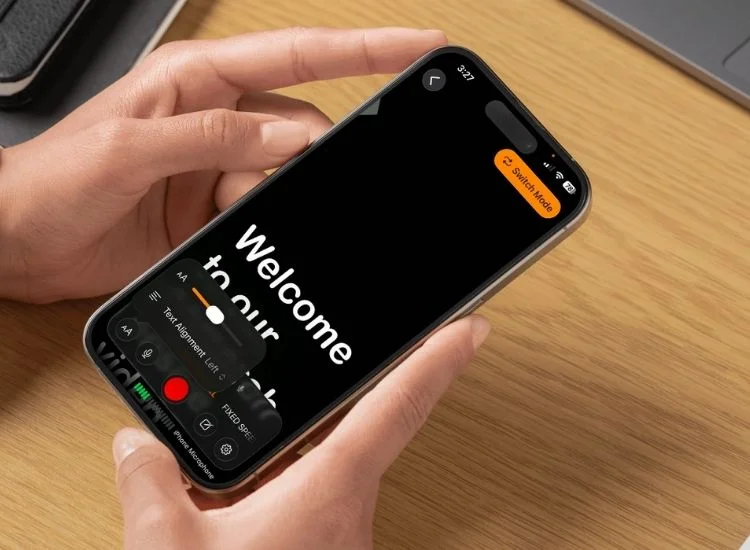
These three work together. Nail all of them, and most of the friction in on-camera delivery disappears before you hit record.
The best font for teleprompter use is whichever one you stop thinking about while reading it. Arial is the strongest all-around default. Times New Roman works well for longer, denser scripts. OpenDyslexic reduces character confusion for readers who find standard fonts slow to process. Bionic reading bolds the first half of each word for faster recognition — more on this below.
Test font size at your actual recording distance, not arm's length. Most creators land between 36pt and 52pt. If you are leaning toward the screen, the size is too small. Larger text also naturally slows your reading pace, which almost always improves delivery. Customize your font settings directly in the app.
Tight spacing causes your eyes to hunt for the next line before finishing the current one. That hunting shows up on camera as darting and blinking. The recommended range is 0.5 to 1 — start at 0.8. If your eyes drop before your voice catches up, loosen it. If you are losing your place between lines, tighten slightly. Adjust line spacing in settings and run a 15-second test before a full session.

White or light text on a dark background eliminates glare under studio or window lighting and reduces eye strain over longer sessions. Avoid light text on a light background, especially if you record during the day. Both text and background color are fully customizable in the app.
Those three settings are the foundation. Here is what they look like in practice, from a creator who got them right.
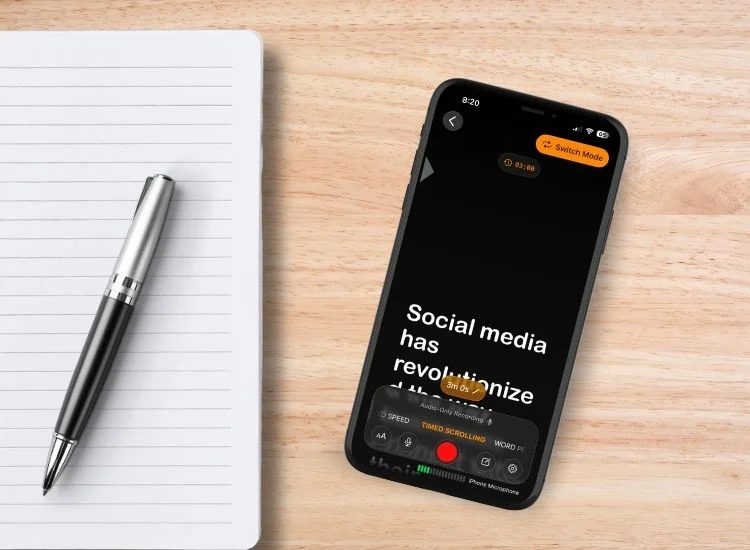
Scrolling speed has the most direct relationship to whether your delivery sounds like a person or someone reading. Most people set it while sitting still with no camera running, and that speed is almost always too fast. Under recording pressure, people read faster. If your speed is already at the ceiling, you will be chasing the scroll within thirty seconds.
A Bluetooth clicker or foot pedal lets you adjust scrolling speed mid-recording without touching the screen, keeping your eye line stable throughout.
Natural conversational delivery runs at 130-150 words per minute. If your scroll speed matches your fastest reading pace, you are not delivering — you are racing.
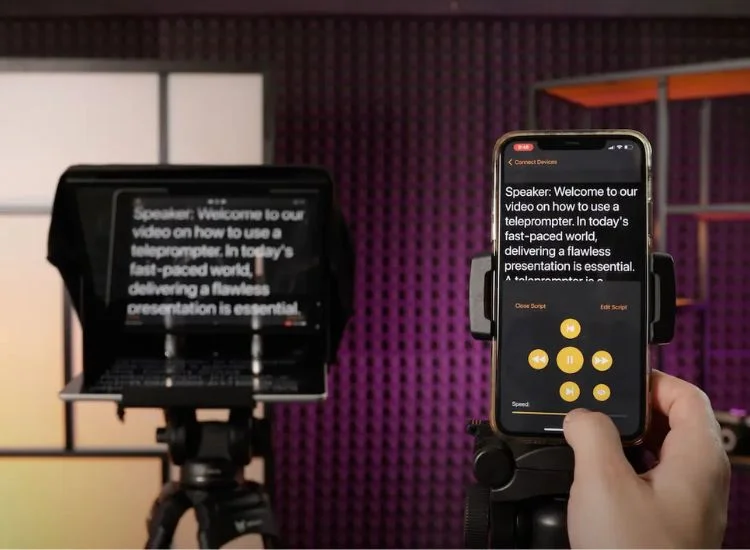
Teleprompter.com works on any device without hardware. If you are using a phone, tablet, or laptop beside your camera, skip to the next section. For physical rigs with two-way reflective glass, two settings matter:
Small setup decisions add up quickly. RDMagnetic, a Mac mini and OSMO Pocket 3 user, found that out on his very first session.
Bionic reading bolds the first half of each word so your brain processes text by recognition rather than decoding. The result: fewer stumbles, smoother delivery through technical vocabulary, and fewer total takes. It benefits any creator recording dense or fast-paced scripts, not just users with dyslexia. Pair it with OpenDyslexic font if standard fonts feel tiring at recording pace. Adjustment takes about two minutes.
Run through this before you hit record. It takes under ninety seconds.
The settings in this guide are not complicated. They take under two minutes to configure and most people only need to do it once. What they fix (visible eye movement, robotic pacing, footage that starts mid-script) are the exact things that make recordings feel unprepared, not the performance itself.
Get your font right. Set your scroll speed. Enable sync scrolling. Run the checklist. Once your settings are locked in, the next step is delivery, and how to read a teleprompter naturally covers exactly that.
The settings in this guide are just the starting point. Teleprompter.com has more features built for creators who want to record better and faster: remote speed control, live streaming, background blur, and more. See what is available on every plan and platform.
The best teleprompter app settings for beginners are Arial font at 40-48pt, line spacing of 0.8, white text on a dark background, a slow scroll speed, and both the countdown timer and sync scrolling enabled. Run a 30-second test take before your first full recording to calibrate scroll speed at your actual recording distance.
Most creators use a font size between 36pt and 52pt, test it at your actual recording distance, not arm's length, since larger text also naturally slows your reading pace for a more natural delivery.
Your teleprompter should scroll at your natural conversational pace, roughly 130-150 words per minute, which is almost always slower than your initial instinct. Record a 30-second test, watch it back with sound off, and use the speed where your eye movement is least visible.
Sync scrolling and recording means your script only starts scrolling the moment your recording begins, so your footage and script stay aligned from the first word. Without it, the script may already be several lines in by the time the camera rolls.
Yes. Teleprompter.com works on any iPhone, Android, iPad, Mac, or web browser with no hardware required. Simply prop your device near your camera lens and read from the screen; the mirror text setting is only needed for physical rigs with reflective glass.
Mirror text horizontal flips your script left to right so it reads correctly in a teleprompter rig's reflective glass, which is what almost all physical setups require. Mirror text vertical flips text upside down and is rarely the correct setting.
Visible eye movement is almost always caused by a scroll speed that is too fast, a font that is too small, or line spacing that is too tight: slow the scroll, increase font size, and loosen spacing until you can read each line in one smooth pass.


.png)


.png)