Guides

Teleprompter Glass: Types, Materials, and How to Care for It

By
Teleprompter.com team
Published on:
December 8, 2023
·
Last updated:
July 8, 2026
Reading time:
5
minutes
Teleprompter Glass: Types, Materials, and How to Care for It
TL;DR:

A teleprompter glass is a specialized, coated panel, often called a beamsplitter or two-way mirror, built to reflect scrolling text toward a presenter while staying clear enough for a camera to record through it. It's the physical component that makes teleprompters work, distinct from the software that displays the script.

TL;DR:

  • Teleprompter glass is a coated beamsplitter panel, not standard glass or a regular mirror
  • It's built on low-iron soda lime glass with a dielectric coating and an anti-reflective backing
  • Glass comes in a few grades, from optical-grade dielectric mirrors to budget beamsplitters
  • Cleaning it wrong is the fastest way to damage the coating and ruin the reflection
  • Ghosting, tint, and distortion are the clearest signs you're looking at low-quality glass

What Is Teleprompter Glass?

Teleprompter glass isn't standard glass, and it isn't a regular mirror either. A regular mirror reflects nearly all incoming light, which is exactly why you can't shoot through one. Teleprompter glass carries a thin coating engineered to reflect part of the light and transmit the rest, letting the presenter read a script while the camera sees straight through the same surface.

This component sits at the center of every hardware teleprompter setup, from newsroom rigs to portable camera-mounted units. The optics behind that split, how much light reflects versus how much passes through, are worth understanding on their own. 

We cover that mechanism, including the standard transmission-to-reflection ratios, in our full breakdown of how teleprompter glass works. This guide stays focused on what the glass is made of, the grades available, and how to keep it in good condition.
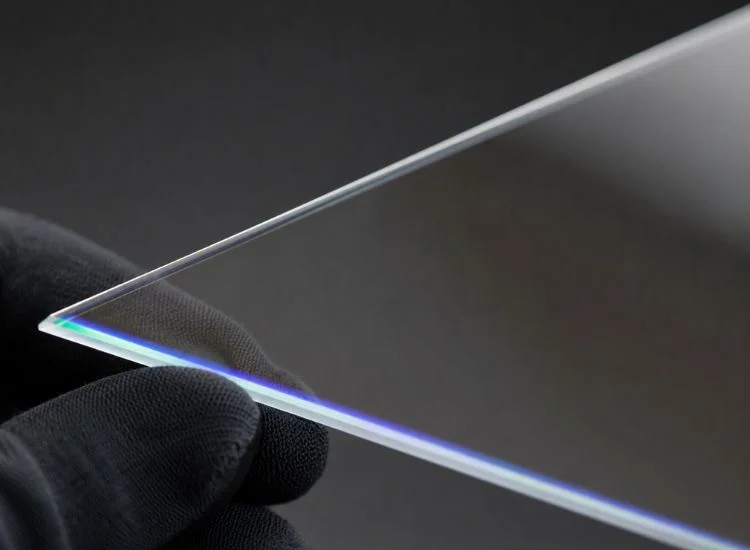
What Is Teleprompter Glass Made Of?

teleprompter glass

The base material is soda lime float glass, the same family of glass used in most flat, clear glass products, chosen for its flatness and consistency. What turns plain soda lime glass into teleprompter glass is what gets added to it.

Manufacturers use a low-iron variant of soda lime glass, which removes the faint green tint you'd otherwise see in standard glass and keeps colors accurate on camera. On top of that substrate sits a thin dielectric coating on the front surface, the layer responsible for splitting light between reflection and transmission, plus a separate anti-reflective coating on the back surface that stops a faint double image, known as ghosting, from appearing in the shot.

Optical suppliers fabricate this glass at scale for broadcast use. Abrisa Technologies, for example, produces teleprompter beam splitters as large as 126 by 88 inches, cut to fit specific rigs (Source: Using Beam Splitters for Teleprompters, Abrisa Technologies). That range, from small camera-mounted panels to studio-sized sheets, is why teleprompter glass shows up in everything from a solo creator's desktop rig to a network broadcast booth.

Teleprompter Glass Grades and Types

Not all teleprompter glass performs the same way, and the difference usually comes down to coating quality and glass substrate.

Grade Clarity Durability Typical Use Price Tier
Optical-grade dielectric beamsplitter Highest, distortion-free High, resists scratching and wear Broadcast studios, film sets, high-stakes recording Premium
Standard beamsplitter (budget) Lower, more prone to slight distortion Moderate Home studios, solo creators, occasional use Budget-friendly
Uncoated glass or plexiglass Poor, produces glare and ghosting Low to moderate Not recommended for teleprompter use N/A

Pro Tip:

If you're comparing two panels of similar size and price, check for a visible anti-reflective coating on the back surface before you check anything else. That single coating is what separates a clean, single reflection from a distracting double image on camera.

To see these ratios and grades attached to actual hardware rather than spec sheets, our roundup of the best teleprompters breaks down real products by beam-splitter quality, price, and use case. 

Where Teleprompter Glass Is Used

Teleprompter glass started in television studios, but the same coated panel now shows up well beyond newsrooms.

  • Broadcast and news: The original use case, where consistent, distortion-free reflection matters most.
  • Corporate video and training: Executives and internal comms teams rely on it for polished, repeatable messaging.
  • Education and e-learning: Instructors use it to record structured lessons without breaking eye contact with the camera.
  • Live events and ceremonies: Awards shows, concerts, and formal programs use it to keep hosts and performers on script.
  • Political speeches: Presidential and podium setups use paired glass panels for high-stakes public address.

Each of these applications runs on the same core component, just mounted differently. Our guide to the different types of teleprompters breaks down camera-mounted, floor, presidential, and software-based rigs in more depth.
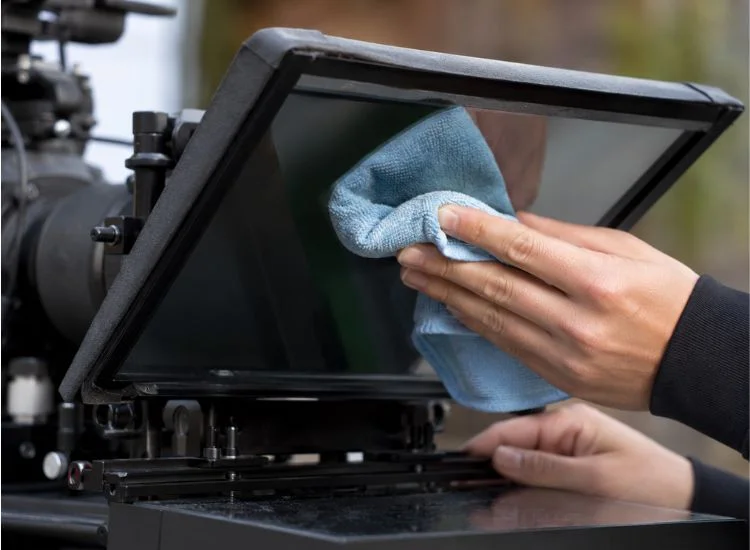
How to Clean Teleprompter Glass Without Damaging the Coating

proper way of cleaning teleprompter glass

The dielectric coating on the front surface is more fragile than the glass itself. Clean it the wrong way and you'll dull the reflection permanently, not just leave streaks.

  1. Remove dust first. Use a lint-free cloth or an electronics duster to clear loose particles before any liquid touches the glass. Dust acts like sandpaper under pressure.
  2. Use a gentle, ammonia-free cleaner. Harsh chemicals break down the coating over time. A cleaner made for coated optics or delicate screens is the safer choice.
  3. Dampen the cloth, not the glass. Spray the cleaner onto a lint-free cloth or paper towel rather than directly onto the panel, so moisture doesn't seep into the edges.
  4. Wipe in light, circular motions. Start at one corner and work across the surface evenly. Pressing hard to remove a smudge is more likely to damage the coating than lift the mark.
  5. Repeat with a fresh cloth if needed. For stubborn spots, use a new section of cloth rather than scrubbing the same smudge repeatedly.

Pro Tip:

Store the glass in a protective sleeve when it's not mounted. Loose glass that rattles around in a case picks up fine scratches that show up as tiny reflection artifacts later, long before the coating itself wears out.

Signs You're Looking at Low-Quality Glass

Before buying or replacing a panel, check for these directly rather than trusting a listing's description:

  • Ghosting: A faint double image of the reflected text usually means the back-surface anti-reflective coating is missing or poorly applied. It can also happen with good glass if ambient light is bouncing off it unchecked, which is a job for a teleprompter hood and shroud, not the glass itself. 
  • Green or yellow tint: Standard soda lime glass, instead of the low-iron variant, shows up as an off-color cast in your footage.
  • Visible distortion at the edges: Cheaper glass often warps slightly near the edges, which shows as a subtle wave in straight lines behind the presenter.
  • Reflection that looks dim even at full brightness: This can point to a reflection ratio poorly matched to your lighting or a coating that's degraded with age.

Your Glass Is Only Half the Setup

Getting the right glass, at the right grade, kept clean and free of ghosting, solves half the equation. The other half is choosing hardware that matches your budget and the way you actually shoot.

See what else Teleprompter.com offers to find a setup that pairs well with the glass you choose.

FAQ

What is teleprompter glass made of? 

Teleprompter glass is built on low-iron soda lime float glass, coated with a dielectric layer that splits light between reflection and transmission, plus an anti-reflective coating on the back surface to prevent ghosting.

What's the difference between optical-grade and standard teleprompter glass? 

Optical-grade glass uses a more precise dielectric coating and higher-quality glass substrate, giving a clearer, distortion-free reflection. Standard or budget beamsplitters are more prone to slight tint or distortion but cost less.

How often should you clean teleprompter glass? 

Clean it whenever you notice dust, smudges, or fingerprints affecting the reflection, and always before a recording session where lighting or glare issues would be costly to fix in post.

Can teleprompter glass be repaired if scratched? 

Light surface scratches on the glass itself usually can't be buffed out without risking the coating. Deep scratches or coating damage typically mean replacing the panel rather than repairing it.

What type of glass is used for a teleprompter? 

Teleprompters use low-iron beamsplitter glass, a coated panel that reflects text while staying clear enough for a camera to shoot through.

Recording videos is hard. Try Teleprompter.com
Recording a video without a teleprompter is like sailing without a compass.

Since 2018 we’ve helped 1M+ creators smoothly record 17,000,000+ videos