Facebook Video Statistics (2026): Data, Trends and Benchmarks
By
Teleprompter.com team
Published on:
April 24, 2026
·
Last updated:
Reading time:
7
minutes
TL;DR:
Facebook video is not coasting in 2026. Meta’s latest reporting points to a clear direction: stronger recommendations, faster content discovery, and more video time spent.
The headline stats make the case quickly:
Video time spent on Facebook grew double digits year over year in the US (reported in Meta’s Q4 2025 prepared remarks published Jan 2026).
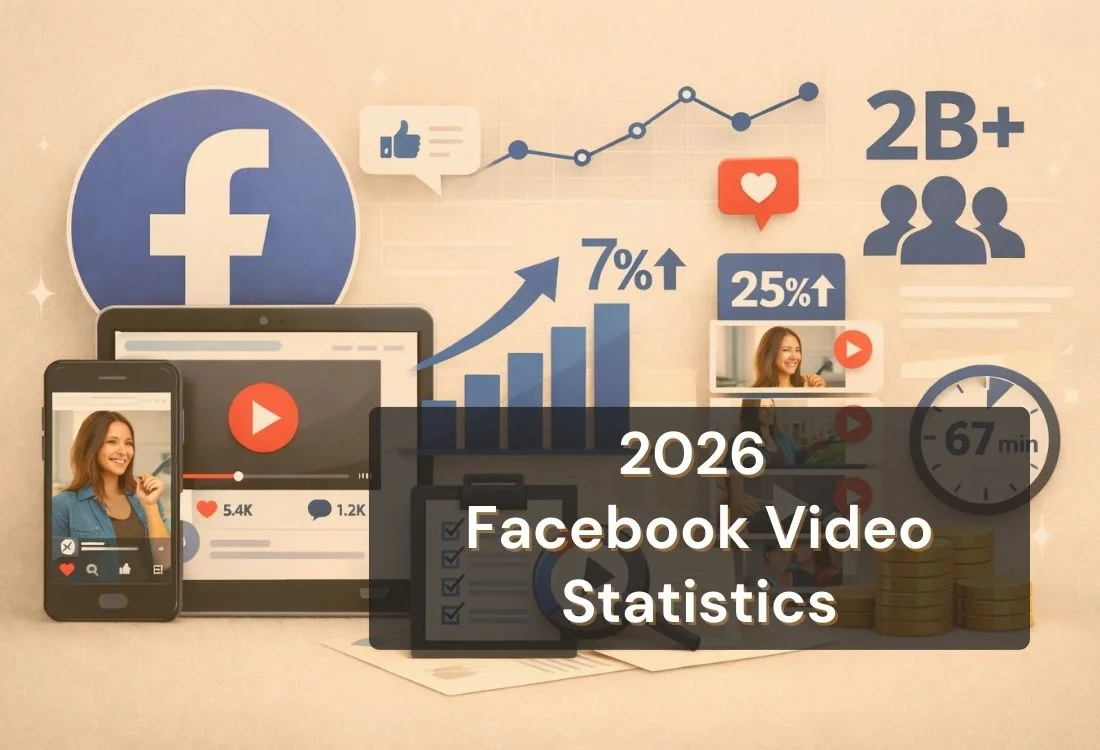
Meta’s Q4 optimizations delivered a 7% lift in views of organic Feed and video posts on Facebook.
Facebook surfaced over 25% more Reels published that day compared to the prior quarter, a signal that “fresh” content matters more than ever.
Facebook is also simplifying publishing: all videos will be shared as Reels and Reels will not have length or format restrictions.
This guide compiles the most useful Facebook Video Statistics for 2026 and translates them into practical benchmarks you can use for content planning, performance reporting, and campaign strategy.
Key Facebook Video Statistics for 2026
Use these in decks, briefs, and stakeholder updates.
Growth and distribution
Facebook video time grew double digits year over year in the US. [1]
Ranking improvements lifted views of organic Feed and video posts by 7% in Q4 2025. [1]
Facebook surfaced over 25% more same day Reels vs the prior quarter. [1]
All videos will be shared as Reels, with no length or format restrictions for Reels on Facebook. [2]
Platform scale and attention
Meta reported more than 2 billion daily actives on Facebook (in Q4 2025 prepared remarks dated Jan 2026). [1]
DataReportal reports that typical Facebook Android users spend 67 minutes per day in the app. [3]
Benchmarks and marketing usage
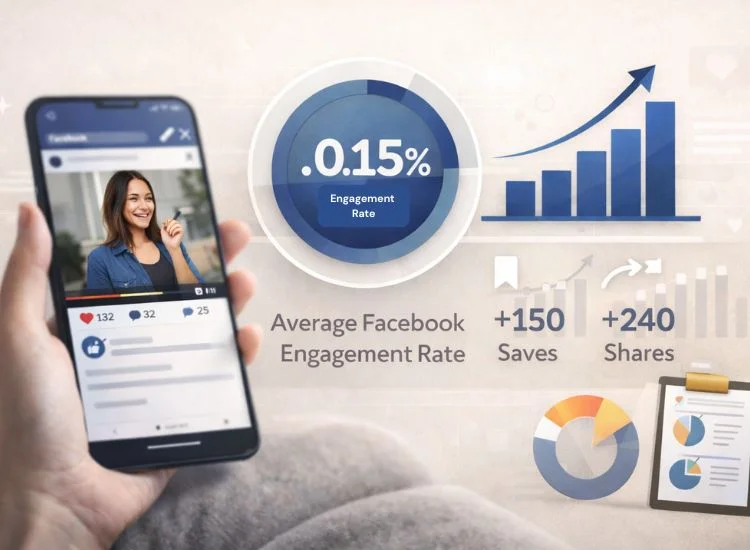
Socialinsider reports an average Facebook engagement rate of around 0.15% in its social media benchmarks (based on a large dataset across 2024 to 2025). [4]
Wyzowl’s 2026 video marketing survey reports 55% of marketers say Facebook is effective for video marketing (survey fielded in late 2025). [5]
Meta previously disclosed that Reels plays exceeded 200 billion per day across Facebook and Instagram (older but still commonly cited for format scale). [6]
What Changed for Facebook Video in 2026
The biggest shift is not a single feature. It is the combination of:
A Reels-first publishing model
Stronger recommendations and ranking
A bigger emphasis on freshness and original content
Meta described this direction clearly in its Q4 2025 prepared remarks and in its January 2026 blog update on AI and performance. [1]
Facebook is moving toward one video system
Facebook announced it will streamline creation so that all videos will be shared as Reels, eliminating the need to pick between “video” and “Reel.”
What that means for creators and brands:
Your videos enter a discovery-heavy feed by default
Short and long videos live under a unified viewing experience
Creative pacing and retention signals matter more because recommendations drive reach
Facebook Video Consumption Statistics: Time Spent and Watch Behavior
If you need one stat to justify ongoing investment in Facebook video, use this:
On Facebook, video time continued to grow double digits year over year in the US. [1]
That growth lines up with Meta’s broader effort to upgrade recommendations and keep people watching.
Attention signals you can reference in planning
Pair Meta’s growth commentary with “time in app” estimates to explain why video impressions remain plentiful:
67 minutes per day is the typical time spent by Facebook Android users, based on Similarweb data reported by DataReportal. [3]
Practical implications for your content
When time spent and recommendations improve, the platform often rewards:
Repeatable formats that train the algorithm and the audience
Use this checklist to align with 2026 consumption patterns:
Put the payoff upfront (result, takeaway, transformation)
Use captions by default
Keep scenes moving with frequent visual changes
Cut setup lines that do not add meaning
Build “series” content so people know what to expect
Facebook Video Reach Statistics: How Discovery is Changing
In 2026, reach is less about follower counts and more about distribution systems.
Meta reported:
A 7% lift in views of organic Feed and video posts on Facebook, driven by Q4 optimizations. [1]
Over 25% more Reels published that day surfaced versus the prior quarter, showing a push toward timely content. [1]
What “freshness” means in real workflows
If Facebook surfaces more same day Reels, you should consider:
Posting closer to when your topic is relevant
Publishing faster reactions for trends in your niche
Repurposing quickly, not perfectly
A practical system for “fresh” content:
Record one core script
Cut 2 to 4 variations with different hooks
Publish within 24 hours if the topic is time-sensitive
Update the caption and on-screen text for each version
Facebook Reels Statistics and What to Do With Them
Your Reels section works best when it covers two angles. First, focus on signals that affect how Facebook distributes Reels right now. Second, use broader Meta-wide Reels adoption as context, not as a performance promise.
1) Facebook-specific signals you can act on
These signals tell you how to shape your publishing habits and creative so your Reels fit what Facebook is rewarding.
What to do with them:
Post for relevance: Build quick-turn videos around questions people are already asking in your niche.
Design for the first seconds: Start with the payoff, then deliver steps or proof immediately.
Treat each Reel like it competes in a feed: Tight edits, captions, and clear structure matter more than fancy production.
Test variations fast: Publish multiple hooks for the same topic to learn what earns attention.
2) Broader format scale across Meta apps (use as context)
Meta-wide Reels adoption helps explain why the format matters, but it does not predict your reach.
How to use scale stats responsibly:
Say “across Facebook and Instagram” when relevant.
Use scale numbers to support a strategy shift toward Reels, not to set view targets.
Pair platform-scale context with your own benchmarks, so expectations stay realistic.
Best practice: Treat platform stats as the “why” behind your focus, and treat your analytics as the “how” you improve.
Facebook Video Engagement Statistics: What Benchmarks Look Like
Facebook engagement rates often look lower than short-form-first platforms, even when performance is healthy. That is why benchmarks matter.
Socialinsider’s benchmarks report:
Average Facebook engagement rate around 0.15%. [4]
How to use this benchmark correctly
Do not apply one global number to every page and niche. Use it as a baseline, then compare:
Your industry (education vs entertainment vs B2B)
Your content type (talking head vs montage vs demos)
Your post mix (organic only vs boosted)
Better engagement signals for Facebook video in 2026
If you want metrics that track with distribution and outcomes, prioritize these:
Average watch time
Completion rate (especially for shorter videos)
Shares and saves (strong “value” signals)
Profile visits after video spikes
Link clicks and conversions when you retarget viewers
Facebook Video Marketing Statistics: Where Marketers Still See Value
Wyzowl’s 2026 video marketing report includes a clear platform effectiveness stat:
55% of marketers say Facebook is effective for video marketing. [5]
This is useful for stakeholder alignment because it frames Facebook as a mainstream part of the mix, not a legacy channel.
Retargeting (video viewers are strong warm audiences)
Educational explainers that earn saves and shares
Short clips that lead to longer-form assets elsewhere
What These Facebook Video Statistics Mean for Your 2026 Strategy
Stats only matter if they change your next move. Here is how to translate the numbers into action.
1) Build for a Reels-first experience
Facebook’s video experience now favors fast, mobile-first viewing. Treat every upload like it needs to earn attention in a scroll-heavy feed where people decide quickly what to watch next.
On Facebook, the videos that keep people watching tend to travel farther. Instead of chasing spikes, focus on tightening the experience so viewers stay through the core takeaway.
Retention improves when you:
Keep intros short
Speak in concrete steps
Use examples early
Trim repeated phrases
3) Publish with freshness in mind
Timely posts often get rewarded because they match what people are interested in right now. A consistent posting rhythm also helps you learn faster, because you get more feedback loops from your audience.
A simple “freshness” schedule:
3 to 5 posts per week for consistent training
1 rapid-response post when your niche has breaking news
1 repurposed post from your best-performing topic
4) Set expectations using benchmarks, then measure lift
Benchmarks help you set a realistic baseline, but your real goal is steady improvement. Choose a small set of signals that reflect attention and intent, then track changes over time so you can see what your creative tweaks actually fix.
Track lift in:
Watch time
Shares per 1,000 views
Saves per 1,000 views
Click-through rate on video retargeting ads
Practical: A Facebook Video Metrics Checklist for 2026 Reporting
Use this list when you review weekly or monthly performance.
Core distribution
Reach
Impressions
Unique viewers
Watch and retention
Average watch time
Completion rate
3-second views (if available)
Thruplays or 15-second views (common in paid reporting)
Engagement quality
Shares
Saves
Meaningful comments (not just emojis)
Business outcomes
Link clicks
Leads
Purchases
Cost per result (for paid)
Conclusion
Facebook video in 2026 rewards clear messaging, strong pacing, and content that earns attention fast. If you want steadier results, focus on repeatable formats, tighter scripting, and retention-friendly edits. Track watch time, shares, saves, and clicks, then refine what works. Consistency beats one-off “viral” attempts every time.
FAQ
Are Facebook videos now Reels in 2026?
Yes. Facebook is moving toward a single video publishing flow where uploads are shared as Reels. This simplifies posting and makes mobile-first viewing the default, so your hook, captions, and pacing matter more than ever.
What is the best length for Facebook videos in 2026?
There is no single best length. Short videos win when the idea is simple and fast. Longer videos work when you deliver value early, use clear sections, and keep visuals moving. Let retention decide, not a fixed time target.
How do I increase watch time on Facebook videos?
Open with the result, not your intro. Use captions, cut filler lines, and change visuals every few seconds. Keep steps concrete and front-load your best tip. End with one clear action like “save” or “share” to signal value.
What should I track besides views on Facebook video?
Track average watch time, completion rate, shares, saves, and click-through rate if you drive traffic. Views can spike without impact. These metrics show attention and intent, which are better predictors of reach and downstream results.
How do I script Facebook videos that sound natural?
Write for speaking, not reading. Use short sentences, one idea per line, and a clear structure: hook, proof, steps, recap, CTA. Rehearse once, then record with a teleprompter app at a comfortable scroll speed so delivery stays conversational.
Resources:
[1] Meta Platforms, Inc. (META), Fourth Quarter 2025 Results Conference Call – Prepared Remarks (2026)
[2]Meta: Making it Easier to Create Videos on Facebook
[3]Datareportal: Digital 2026: 2 in 3 people on Earth now use social media
[4]Social Media Today: 2026 Social Media Benchmarks





.png)


.png)