Since launching in 2016, TikTok has rapidly evolved from a short-form lip-syncing app into one of the most influential platforms in the creator economy. As of July 2025, TikTok has reached 1.94 billion adult users worldwide—a scale that rivals the populations of entire continents and cements its position as a global media powerhouse.
The difference reflects varying methodologies (counting adults only versus total users), but all agree that TikTok is now the fifth‑largest social network globally. The U.S. alone hosts 170 million monthly active users and 82.2 million daily users, making TikTok an indispensable channel for digital marketers, content creators, and social media enthusiasts.
TikTok’s influence extends far beyond teenagers dancing. The platform has become a marketplace, a news source, a search engine, and a hub for the creator economy. Brands invest billions in advertising, while everyday users monetize through brand deals, livestream tips, e‑commerce, and TikTok’s Creator Fund.
This report synthesizes the most up‑to‑date statistics from 2025, offering insights into user growth, engagement, geographic distribution, content trends, and monetization. Whether you’re a marketer planning your next campaign or a creator looking to maximise earnings, these numbers provide a data‑driven roadmap for success.
TikTok’s user base continues to surge. According to Backlinko, the platform has about 1.12 billion MAUs and an advertising audience of 1.94 billion. Affinco puts total monthly active users slightly higher at 1.58–1.59 billion, while SQ Magazine reports 1.92 billion MAUs and 1.12 billion daily active users. Differences are due to measurement periods (e.g., first half of 2025 vs. mid‑2025) and whether adult‑only users or all accounts are counted. Regardless, TikTok dwarfs competitors in growth rate; its advertising reach is roughly equal to Instagram’s.
Downloads remain robust. The app was downloaded 244.51 million times in Q1 2025, followed by 192.31 million in Q2 2025. Despite the seasonal dip, 2025 downloads exceeded most quarters in 2024, signalling sustained interest. TikTok’s adoption continues even in markets where it faces political scrutiny; the U.S. still accounts for 24% of platform visits, and only a few countries—including India, Iran, Nepal, and Somalia—have enforced bans.
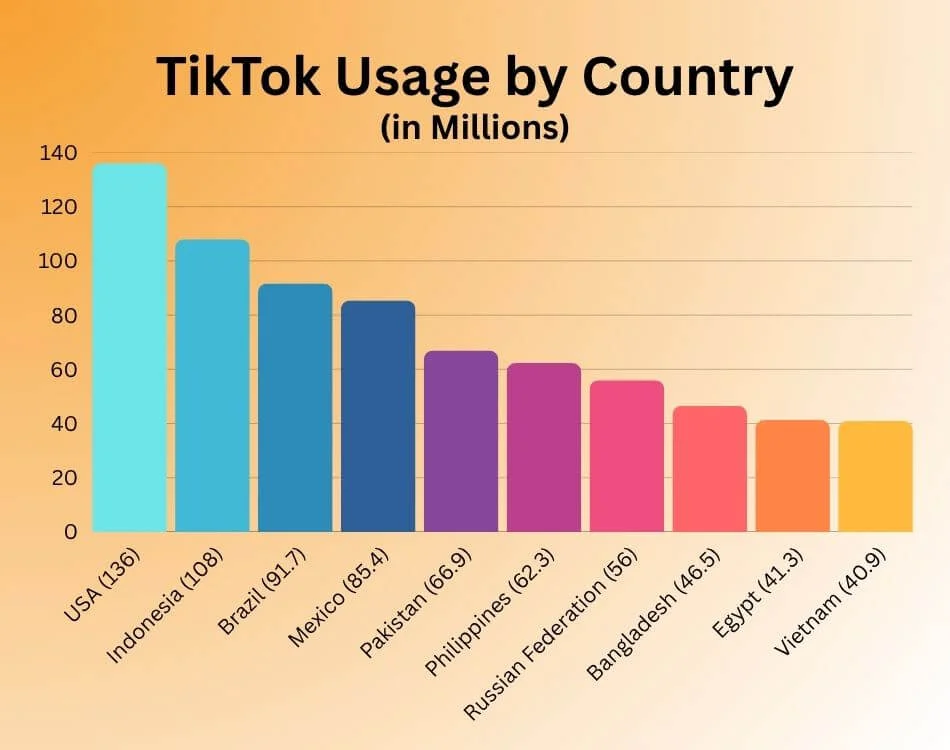
The United States leads with roughly 136 million active users, followed by Indonesia (108 M), Brazil (91.7 M), Mexico (85.4 M), and Pakistan (66.9 M). The Philippines, Russia, Bangladesh, Egypt and Vietnam round out the top ten, each hosting 40–62 million TikTokers. China’s domestic version, Douyin, adds another 755 million MAUs—a reminder that ByteDance’s social video empire is even larger than TikTok’s footprint alone.
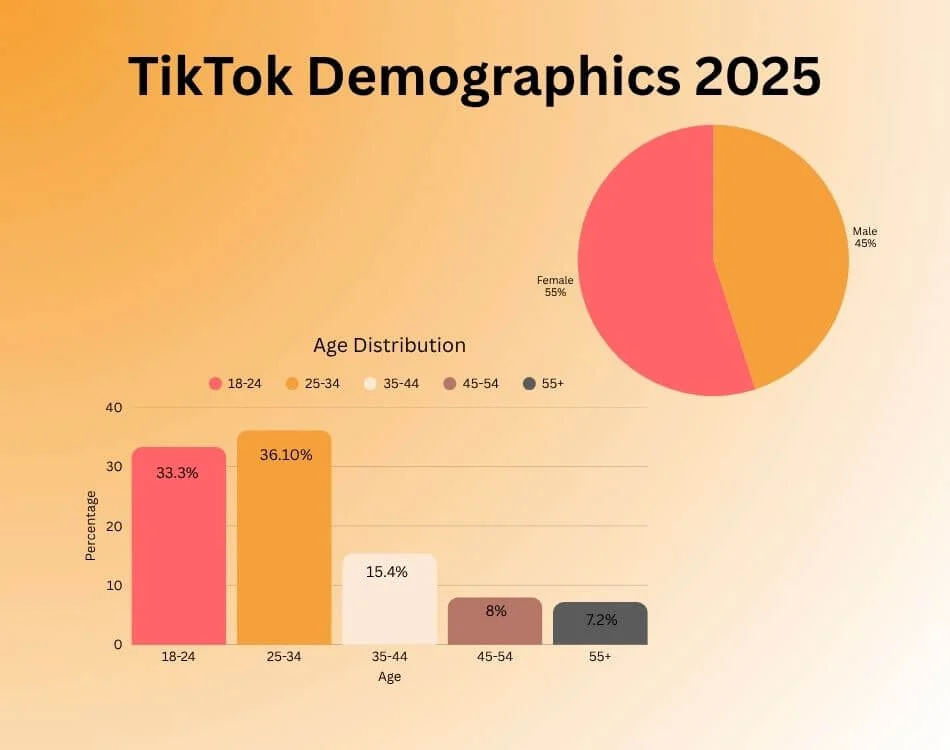
TikTok’s audience is diversifying as it matures. Gender remains relatively balanced, with 55% of weekly U.S. users being female and 45% male. TikTok also skews young but not exclusively teenage.
Backlinko reports that weekly U.S. users are 25% aged 18–24, 30% aged 25–34, 19% aged 35–44, 13% aged 45–54 and 14% aged 55 +. SQ Magazine similarly finds that the 25–34 segment is the largest globally (36.1%), followed by 18–24 (33.3%), 35–44 (15.4%), 45–54 (8%) and 55 + (7.2%). Older cohorts are growing; Gen X and Boomers increasingly use TikTok for tutorials, recipes, and news.
TikTok is also one of the few platforms where millennial and Gen Z usage is nearly equal; the 25–34 age group has overtaken 18–24 in the U.S. since 2022. This broadening appeal makes TikTok attractive for brands targeting multiple generations. The majority of creators are 18–24 years old, but older professionals (chefs, finance experts, teachers) now attract significant followings.
TikTok’s stickiness is legendary. Global users spend around 95 minutes per day on the app, more than on any other social network. Affinco lists daily usage between 90–95 minutes and notes that U.S. adults spend 52 minutes per day, roughly 34 hours and 56 minutes per month.
SQ Magazine reports slightly different numbers—73 minutes globally and 82 minutes in the U.S., with 18–24‑year‑olds clocking 89 minutes. Variations reflect different survey samples, but all sources agree that TikTok outranks Instagram and Facebook in time spent.
Engagement goes beyond time. TikTok visitors view an average of 7.2 pages per session and stay roughly 10 minutes and 38 seconds per visit, according to Affinco. Users watch around 280 videos per day and often lose track of time—61% of users admit to binge‑scrolling. The platform’s 30‑day retention rate is 43.7%, reflecting strong habitual use.
Content interacts with format. Videos under 15 seconds have a 72% completion rate, and posts with trending audio garner 68% more views. Short captions (<100 characters) improve engagement by 21%, and adding subtitles increases completion by 12%. TikTok’s features encourage participation: duets and stitches increase engagement by 33%, while hashtag challenges routinely generate 4.3 billion views in their first week.

TikTok is truly global, but usage intensity varies. The Asia‑Pacific region accounts for roughly 45% of the user base, followed by the Middle East & North Africa (MENA) with 233.9 million users. Latin America hosts 189.7 million and is experiencing double‑digit growth. North America (mainly the U.S.) contributes 122.4 million users, while Europe adds 102.6 million. Nigeria is the fastest‑growing market, up 42% year over year, and the U.K. enjoys a 71% penetration among Gen Z. Australia’s 9.6 million users are relatively small but highly engaged.
Outside of the core TikTok app, ByteDance operates Douyin in mainland China, which boasts 755 million monthly active users. This separation means that global statistics often exclude China, yet Douyin’s trends (e‑commerce integration, hyper‑localised content) foreshadow features coming to TikTok.
TikTok’s algorithm turns everyday people into stars, but what genres dominate? In 2025, educational content such as STEM, finance, and personal development is one of the fastest‑growing categories, experiencing 40% year‑over‑year growth. Fitness and sports influencers have the highest average engagement rate at 18.36%, followed by food & drink (6–8%) and educational creators (11.29%). Life‑hack videos and mini‑documentaries are up 47% in watch time.
Short‑form remains king; videos under 15 seconds achieve the best completion rates, yet TikTok continues to promote longer formats through series and creator playlists. Creators increasingly repurpose clips into duets, stitches, and reaction videos, driving user participation and boosting the algorithmic ranking of original posts.
Gen Z uses TikTok not only for entertainment but also for news (63%) and product discovery (77%). Three‑quarters of teens report using the app for more than an hour daily, and 72% of Gen Z check TikTok multiple times per day.
TikTok’s creator ecosystem is now a multi‑billion‑dollar economy. The platform hosts about 2 million content creators and continues to attract marketers. Influencer marketing spend on TikTok is expected to reach $15 billion by the end of 2025, with categories like fashion, beauty, fitness and gaming driving the bulk of deals.
Micro‑influencers (10–50 K followers) generate the highest engagement at 7.3% and command rates of $700–1,200 per month, while top creators with 5 million + followers can earn over $2 million annually.
TikTok’s monetization options are diversifying:
In total, TikTok creators earned $4.1 billion in 2024, with projections of $5.7 billion in 2025. 62% of creators use multiple revenue streams, and over 1.5 million creators are verified, indicating a professionalizing industry. As more monetization tools roll out, such as subscription models and longer videos, TikTok will increasingly compete with YouTube and Instagram for creator loyalty.
TikTok’s e‑commerce arm, TikTok Shop, has grown from experiment to powerhouse. In its first year in the U.S., TikTok Shop generated $9 billion in gross merchandise value (GMV) and onboarded 398,000 active stores. Global GMV is expected to reach $30 billion in 2025. The platform’s Black Friday 2024 event delivered $100 million in U.S. sales in a single day.
Consumer behaviour reflects the seamless blend of entertainment and shopping: 25% of Gen Z browse TikTok Shop daily, one‑third of U.S. users made a purchase through the app in 2024, and 63% use TikTok for product research. As TikTok integrates shopping links into more videos and lives, expect the boundary between content and commerce to blur further. Brands should adapt by treating TikTok as both a discovery channel and a sales platform.
For advertisers, TikTok offers massive reach at relatively low cost. The advertising audience is about 1.59 billion and will grow as more adults join the platform. In 2024, TikTok generated $20–26 billion in global revenue, with around $10 billion from the U.S. alone.
Global ad revenue is forecast to exceed $23.6 billion in 2025 and could reach $33.1 billion according to some analysts. ByteDance (TikTok’s parent company) reported $12.8 billion in global app revenue by March 2025.
TikTok ads remain cost‑effective. Average cost‑per‑click (CPC) ranges from $0.07 to $0.12, cost‑per‑mille (CPM) averages $4.20–$9.00, and click‑through rates (CTR) hover around 1.20%.
Ad engagement rates are about 1.90%, while dynamic showcase ads drive Gen Z to research products—74% of Gen Z users search for more information after seeing such an ad. Over 7 million U.S. small‑ and medium‑sized businesses use TikTok ads, and marketers expect influencer campaigns to deliver a return on investment (ROI) of $4.5–5.2 per dollar spent.
However, brands face challenges. 58.2% of marketers report difficulty driving traffic to external websites from TikTok, and regulatory uncertainty (such as the threatened U.S. ban) introduces risk. Successful campaigns treat TikTok not as a link‑drop platform but as a storytelling medium; content should be natively entertaining, with calls to action integrated organically.
Political headwinds continue to shape TikTok’s future. India banned the app in 2020, costing TikTok roughly 200 million users. Iran, Nepal and Somalia have also instituted bans, and the U.S. Congress periodically debates restricting the platform due to national‑security concerns. While no national ban has materialized in the U.S. as of late 2025, creators should be prepared for platform volatility and diversify their presence across multiple networks.
Culturally, TikTok is shifting from a dance‑and‑prank playground to a knowledge and commerce hub. Users increasingly consume educational content, financial advice and news. The app’s algorithm, once known for trending dances, now surfaces mini‑documentaries, political commentary and long‑form tutorials. This diversification broadens TikTok’s appeal but may also invite more regulation around misinformation and advertising disclosure.
Several emerging trends will shape TikTok’s next chapter:
TikTok’s 2025 statistics paint a picture of a platform that is both massive and rapidly evolving. With up to 1.94 billion users, engagement times that dwarf rivals, and a booming creator economy, TikTok offers unparalleled opportunities for marketers and content creators. However, competition and regulation are intesifying. To stand out in an increasingly competitive environment, creators need to master storytelling, understand their audience, and leverage every available tool.
In the highly competitive TikTok landscape, creators can significantly benefit from using a teleprompter. This tool allows for pre-scripted content and smooth delivery, eliminating awkward pauses and enhancing viewer retention and professionalism. As brand deals and educational content become more common, a teleprompter helps creators deliver concise, confident messages.
Sign up at Teleprompter.com today to streamline your delivery and bring more polish to every TikTok video.
References:
Backlinko: TikTok Statistics You Need to Know
SQ Magazine: TikTok Statistics 2025
AFFiNCO: TikTok Statistics 2025: Users, Growth & Revenue Trends Data
Castmagic: TikTok Users by Country in 2025: Global Stats & Rankings
Exploding Topics: TikTok User Age, Gender, & Demographics (2025)


.png)


.png)