

A teleprompter beats memorization for most on-camera work, because it removes the mental load of recall so you can focus on pace, tone, and eye contact instead of what comes next. Memorization still wins for short talks, live stages without a screen, and moments where the words need to feel fully your own.

The main difference is where your brain does the work.
With script memorization, you hold the script in your head and pull it out line by line. That takes focus. It also adds stress when you hit a tricky part or lose your place. You may sound fine at first, then slip later in the take.
With a teleprompter, the words stay in view near the camera lens. You don't have to search for the next line in your mind. You can put more attention into pace, tone, and how you look on screen. That shift often leads to a smoother take.
For a related comparison, see teleprompter vs. traditional script reading.
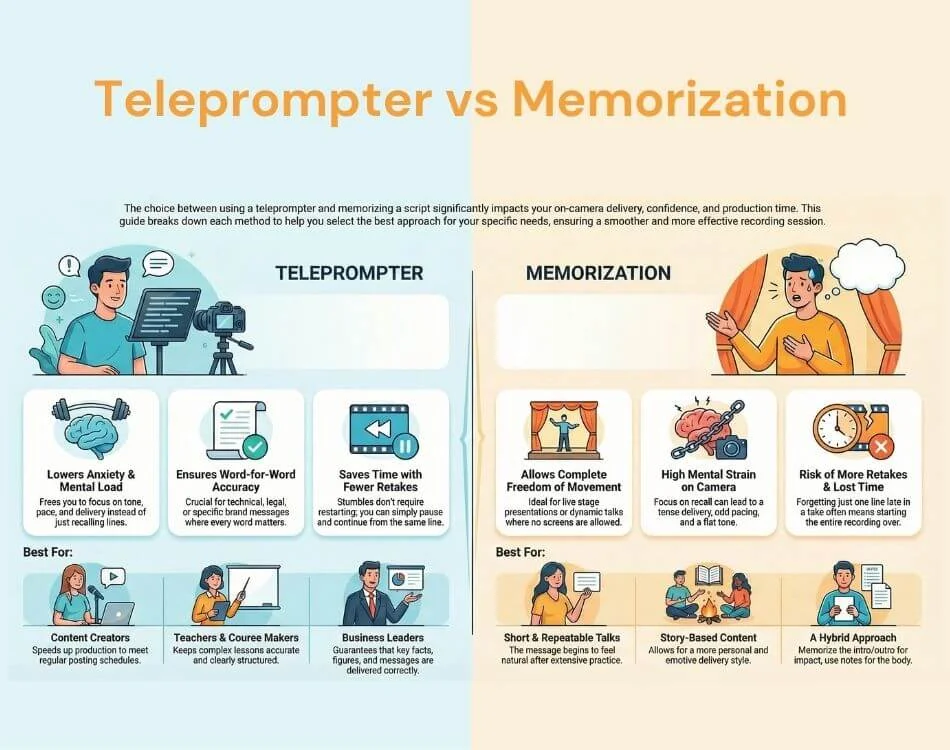
Here's how the two methods stack up on the factors that matter most for video.
Neither method is wrong on its own. The right pick depends on script length, how exact the wording needs to be, and how much time you have.
Memorizing a script is work. You repeat lines until they stick, then try to say them in order while staying relaxed. That's harder than it sounds, even for strong speakers.
When you record video, the pressure goes up. The camera makes small slips feel big. If you forget one phrase, your mind can stall. That pause can change your tone and your pace, and it can break your flow.
A quick way to spot the strain is to time your prep. A two-minute script may take a short session to lock in. A five-minute script can take much longer. Memorization asks for more time as scripts grow.
Memorization shines when the message is short and repeatable. If you give the same pitch often, it can be worth the effort. The words start to feel natural, and you can move more while using less gear.
It also fits settings where screens aren't an option. Some live events don't allow tools. Some stages make it hard to place a device near the lens line.
Even then, many speakers don't memorize every word. They lock in the key beats and speak the rest in their own voice. That keeps the talk warm and less stiff.
For video, memorization tends to cause a few recurring issues:
The cost of memorization is often paid in time. Each restart adds minutes, and those minutes add up fast. One creator ran into that exact cost before switching methods:
"I record videos with a lot of detail, so memorizing the script was too difficult and time consuming. And repeatedly glancing at my notes broke eye contact with viewers... Now I feel much more confident recording videos using auto scroll." — RyahWood, United States, May 2026
An online teleprompter shows your script close to the camera lens. The text scrolls at a set speed, or you move it yourself by touch or keys. Your eyes stay up, so the viewer feels like you're speaking directly to them.
A teleprompter app also gives you control over the reading feel. You can adjust text size and line spacing, which makes it easier to read without darting your eyes. That small change can make you look steadier on screen.
The biggest benefit is mental relief. When the words are right there, you can relax, and that calm shows up in your voice and face. It also helps you hold a steady pace.
A teleprompter cuts retakes too. If you stumble, you can pause and pick back up from the same line instead of starting the whole section over. That saves time and keeps your energy stable across a long session.
Some scripts need exact wording. Think safety notes, product claims, or steps in a lesson. A small change can cause a real problem, and a teleprompter helps you stay true to the script.
This matters for teams too. If more than one person records the same message, a teleprompter keeps the wording tight and uniform across every version.
Creators film often, so speed matters. If you memorize each script, prep time grows fast, and it gets harder every time you change a line, since you then have to re-learn the part you edited.
With a teleprompter, edits are quick. You can adjust a hook, a brand line, or a call to action, then record again right away. If you want a simple rule, teleprompters tend to fit creators who post on a schedule and need repeatable output.
Teaching video has little room for drift. If you skip a step, a learner may miss the point. Memorization can help, but it can also lead to slips when the lesson runs long.
A teleprompter keeps the order clear and supports key terms, names, and numbers. Course makers often pick a teleprompter for long modules, since it lowers fatigue and keeps the lesson clean.
Leaders record updates, sales clips, and public messages that often include dates, goals, or key facts. Small errors here can cause real confusion, and memorization raises the chance of a missed word or a swapped number.
A teleprompter helps leaders speak with calm and control. For many teams, the choice becomes simple when time is tight and the words have to be right.
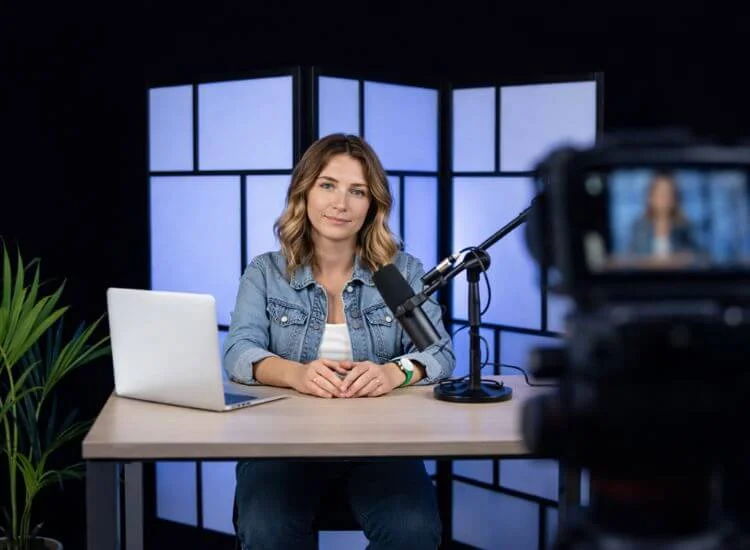
Eye contact matters on camera. It helps people feel like you're talking to them, not at them, and it supports trust. Research on eye contact (Journal of Nonverbal Behavior) links it to trust, comfort, and how people judge an interaction, including in care and service settings.
Memorization can pull your focus inward. When you search for a line, your eyes may drift and your face may tense, and the viewer notices.
A teleprompter keeps your gaze near the lens, which helps you look steady. This is one of the clearest on-screen wins, especially if you feel stress during recall.
If your video drags, people drop off, even when the content is good. Wistia's reporting on video engagement shows that keeping viewers depends on clear structure and strong delivery as engagement shifts across video lengths.
Delivery method plays into that directly. When a speaker spends less mental effort on recall, they can put more focus on meaning. They can pause at the right moment, stress key words, and sound like a person instead of a script.
Here's a practical example: a manager records a weekly two-minute update. With memorization, they need many takes because one missed line ruins the flow. With a teleprompter, they often finish in fewer takes because they stay calm and keep moving. The message stays clear, and the time cost drops.
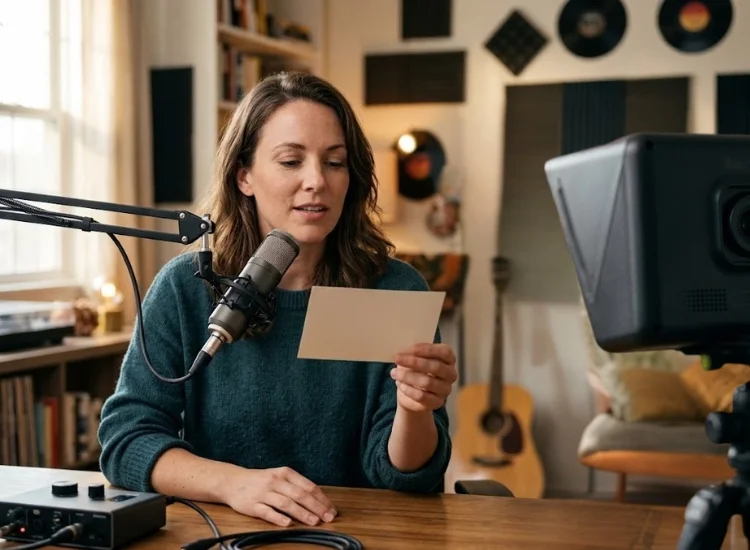
Memorization is the right pick when you need freedom to move or speak without any tools. It also fits short talks that lean on story and feel, since some lines land best when they live in your voice instead of on a screen.
Memorization also works well when you know the topic so well that the script is more of a guide than a strict track. In that case, you may not need every word. You need the structure.
A useful hybrid method:
This keeps your start strong and your close clean, and it lowers stress in the middle. If you want those opening and closing lines to stick faster, here's how to memorize a script using a teleprompter with repetition, voice-following, and review built into the practice.
If your script runs over two minutes, memorization gets harder fast. A teleprompter often saves time and lowers errors as length grows.
If you have to hit exact lines, a teleprompter helps. This is common for product demos, training, and legal or safety notes.
If you need to record today, memorization may not fit your timeline. A teleprompter can cut prep and speed up your first clean take.
Some speakers freeze when they try to recall lines under pressure. If that sounds like you, teleprompter support can help you stay calm and present.
You can also test both methods in one short session. Record the same 45-second script two ways, then compare how many takes you needed, how your voice sounded, how your eye contact looked, and how long the whole process took.
The best choice between a teleprompter and memorization is whichever one helps you speak clearly with less strain. Memorization can work well for short talks, live stages, and story-based clips, especially when you have time to rehearse.
A teleprompter helps when scripts run longer, facts need to be exact, and you want fewer retakes. It supports steady eye contact and pacing, and it helps you keep your energy up across a long session.
No, you don't have to memorize the full speech if you have a teleprompter. Use it to keep your wording accurate and your pace steady, then practice enough to sound natural and keep your eyes near the camera lens.
Not if you set a slow scroll and rehearse once. Good pacing and pauses make teleprompter reading sound natural instead of read.
Choose memorization when your script is short, the setting is live, or you need freedom to move without any screen. Many speakers memorize key points and their opening and closing lines, then use a teleprompter for everything in between.
Yes, a teleprompter can help reduce anxiety by lowering the fear of forgetting lines. When the script is visible, you can focus on breathing, tone, and pacing, which often makes you sound calmer and more in control.
Yes, many speakers combine both methods. They memorize the opening and closing lines for a natural start and finish, then rely on a teleprompter for the body to stay accurate and reduce mental strain.


.png)


.png)