


Video testimonials, which feature real customers sharing their experiences on camera, have quickly become one of the most powerful forms of social proof in marketing. Recent video marketing statistics show that video continues to dominate engagement across platforms, reinforcing the value of authentic customer stories in building trust. Seeing and hearing real people share their experiences creates credibility in a way text alone often can’t.
In this article, we’ll explore up-to-date statistics and trends around video testimonials to understand their impact. From trust and engagement metrics to conversion rates and ROI, the data makes a compelling case for incorporating video testimonials into your marketing strategy.
Here are the key stats that show how video testimonials influence consumer behavior and why businesses are investing in them.
It’s no secret that consumers love video content. Across generations, visual formats are more engaging and memorable than text. Viewers retain about 95% of a message when watching it in a video review, compared to only 10% when reading it. This huge difference in recall means video testimonials stick in people’s minds, making your customer success stories far more impactful.
It turns out most consumers actively seek out video testimonials as part of their research:
Why this preference? Video is an easy-to-digest format that conveys emotion and authenticity. Rather than reading flat text, viewers can see a real person’s face, hear the tone in their voice, and observe their genuine excitement or relief.
This creates a human connection. It’s no wonder people of all ages now spend significant time watching user-generated video content – Americans, for example, spend 46% of their media hours consuming content created by other consumers (like testimonial videos, unboxings, reviews, etc.).
Moreover, overall demand for video from brands keeps climbing. A recent Wyzowl report found 83% of consumers want to see more video content from brands in 2024. Testimonial videos align perfectly with this trend, giving audiences the engaging video format they crave while delivering social proof.

Trust is the currency of modern commerce. Potential customers need to trust that your product or service will deliver on its promises. This is where testimonials shine: people trust other people more than they trust brands. Consider these trust-building stats:
Importantly, video format adds extra credibility on top of the testimonial itself. Seeing an actual customer speak removes doubt about whether a quote is real or fabricated. The authenticity and transparency of video helps overcome skepticism.
Why do viewers find video testimonials so effective? Wyzowl’s research uncovered the top reasons consumers say testimonial videos resonate:
These elements: visualization, storytelling, real-life impact, and authenticity – make video testimonials a trust trifecta. A written testimonial might claim a product is great; a video testimonial shows a relatable person benefiting from it, which is far more convincing.
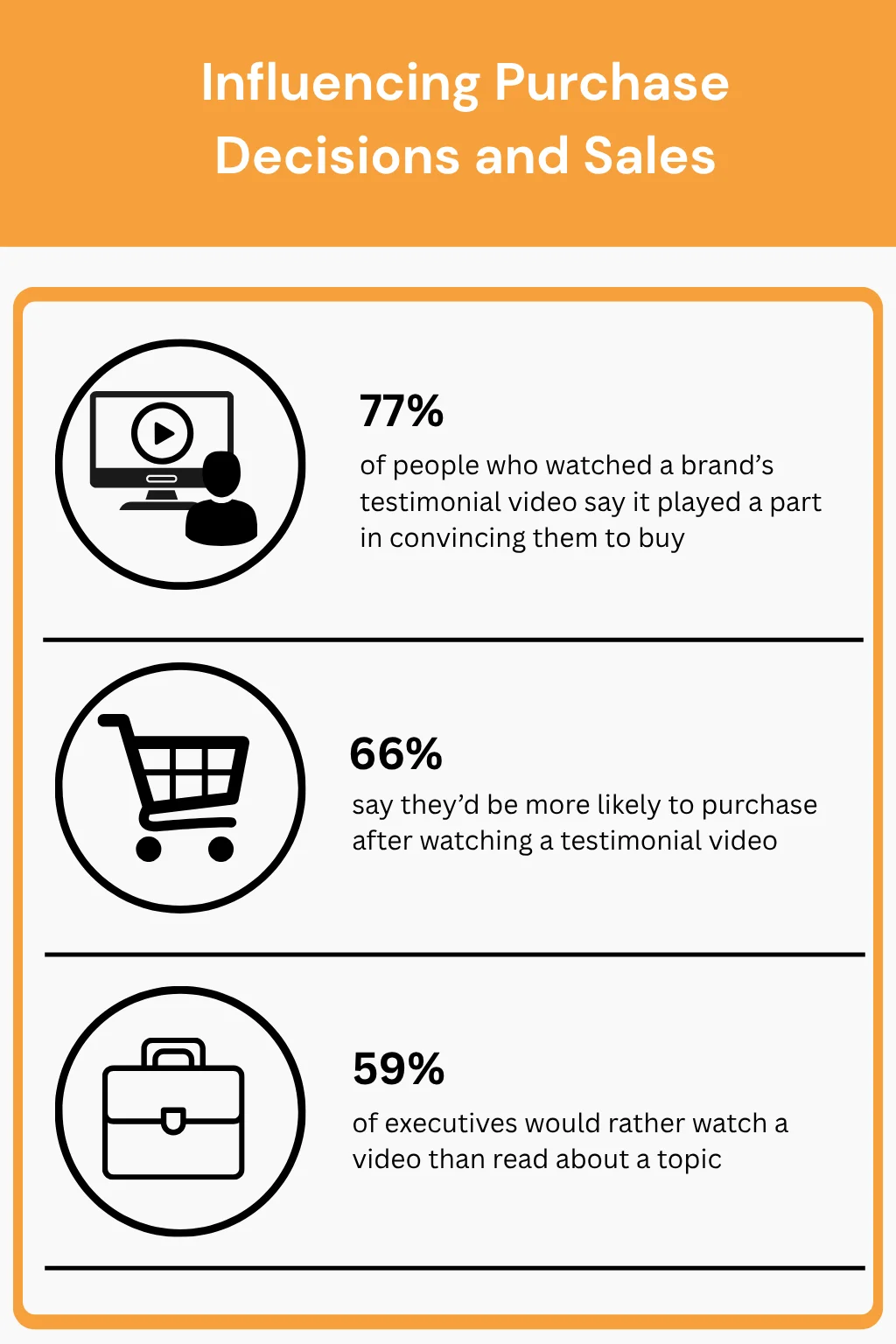
Because they build trust and understanding, video testimonials have a direct effect on buying decisions. Multiple studies indicate that seeing peer testimonials on video pushes consumers closer to purchase:
Perhaps the most eye-opening stat: 79% of people say they’ve been convinced to buy a product or service after watching a video testimonial. This figure (from Wyzowl’s annual consumer survey) really highlights the persuasive power of testimonial videos.
A significant majority of consumers acknowledge at least one instance where a video testimonial swayed them to make a purchase they were on the fence about.
This trend isn’t limited to B2C consumers browsing on YouTube or social media. Even in high-consideration B2B purchases, testimonials carry weight. Approximately 92% of B2B customers read reviews and watch testimonials before buying – virtually all B2B buyers now incorporate social proof into their vetting process.
Executives, often pressed for time, show a strong preference for video content, with 59% opting to watch rather than read about a topic. This highlights the effectiveness of a video testimonial featuring a satisfied client as a compelling tool to secure B2B deals, as it delivers the message in a format preferred by busy decision-makers.
Social proof via testimonials also combats abandonment and doubt late in the funnel. It’s often that last push needed for conversion. For instance, adding a customer testimonial video to a product page or checkout page can reassure hesitant buyers at the critical moment.
One case study by Trustmary found that customers who watched a testimonial video on a product page were significantly more likely to complete the purchase than those who didn’t. Simply giving shoppers that extra proof point at checkout – “here’s a customer like you who is happy with their purchase” – can seal the deal.
What do all these trust and persuasion gains add up to? In practical terms: higher conversion rates and more sales. Marketers have measured notable improvements when they leverage video testimonials:
Given higher conversions, it’s not surprising that video testimonials contribute to a strong return on investment. In fact, many marketing professionals now consider testimonial videos a high-ROI component of their strategy:
Why such robust ROI? Partly because a single testimonial video can be repurposed across many channels, your website, landing pages, social media, email campaigns, even sales presentations, amplifying its value.
Additionally, video testimonials can boost your organic traffic: pages with engaging video content tend to see better dwell time and SEO benefits. One analysis suggests that adding video testimonials can increase a website’s organic search traffic by up to 157% (likely due to higher engagement and shareability of video content).
Marketers also note that video is the most shareable content format. About 51% of people are more likely to share videos with friends than any other type of content. So a compelling customer testimonial video might not just convert the viewer – that viewer may pass it along to others, extending your reach for free. This virality contributes to ROI as well.

With all these advantages, how widely are businesses using video testimonials? The practice is growing quickly, though there’s still plenty of room for more companies to jump on board.
That said, producing high-quality testimonial videos does come with challenges. Surveys of marketers reveal a few key hurdles and trends in video testimonial production:
On the positive side, video marketing budgets are increasing overall, which bodes well for more testimonials. About 85% of video marketers planned to maintain or boost their video spending heading into 2024. And new production methods (like using pre-made templates or mixing in-house footage with some professional help) are helping more marketers get videos made cost-effectively.
For example, 48% of marketers now use a mix of original and templated video content to save time. Approaches like these could make testimonial videos more attainable for businesses of all sizes.
The data is clear – video testimonials are an extremely effective tool for building trust and driving conversions. They combine the persuasive power of peer endorsements with the engaging format of video, creating a form of social proof that today’s consumers respond to. Here’s a quick recap of the most impactful statistics we covered:
For businesses and marketers, the implication of these statistics is that incorporating video testimonials is well worth the effort. The social proof and authenticity they provide can significantly improve how prospects perceive your brand. By building trust and clearly showing the real-world value of your product through customer stories, video testimonials help turn more viewers into confident buyers.
As consumer behavior continues to favor video and genuine content, we can expect testimonial videos to play an even bigger role in marketing in 2025 and beyond. Brands that prioritize collecting and showcasing customer video reviews will have an edge in earning trust and accelerating purchase decisions. If you haven’t experimented with video testimonials yet, the data says it might be time to start – your future customers are waiting to hear (and see) what your current happy customers have to say.
Video testimonials are highly effective: 77% of viewers say they were convinced to buy after watching one. They increase trust and boost conversions significantly.
Testimonial ads perform exceptionally well. They can increase conversion rates by up to 34% and deliver ROI gains of over 100% for many marketers.
About 79% of people have watched a testimonial video, and 88% trust online reviews as much as personal recommendations, showing their strong credibility.
People remember 95% of a message in video form versus just 10% from text. Seeing real customers adds emotion and authenticity to the story.
A teleprompter app helps speakers stay natural and confident, ensuring their message is clear, authentic, and on point without the need for multiple retakes.
Resources:
Yorkshire Podcast Studios: Video Testimonials: The Most Powerful Way to Build Trust in Your Business
Influencer Marketing Hub: Video Testimonial Stats You Need to Know in 2025
Wyzowl: Testimonials Statistics 2020; 27 Stats That Prove the Power of Testimonials!
This Moment: Why B2B Customer Reviews Matter as Much as Consumer Reviews
Trustmary: Video Testimonial Statistics That You Should Mind
Vocal Video: 4 Testimonial Statistics That Show the Power of Social Proof
Famewall: 35 Insightful Video Testimonial Statistics (for 2025)


.png)


.png)


