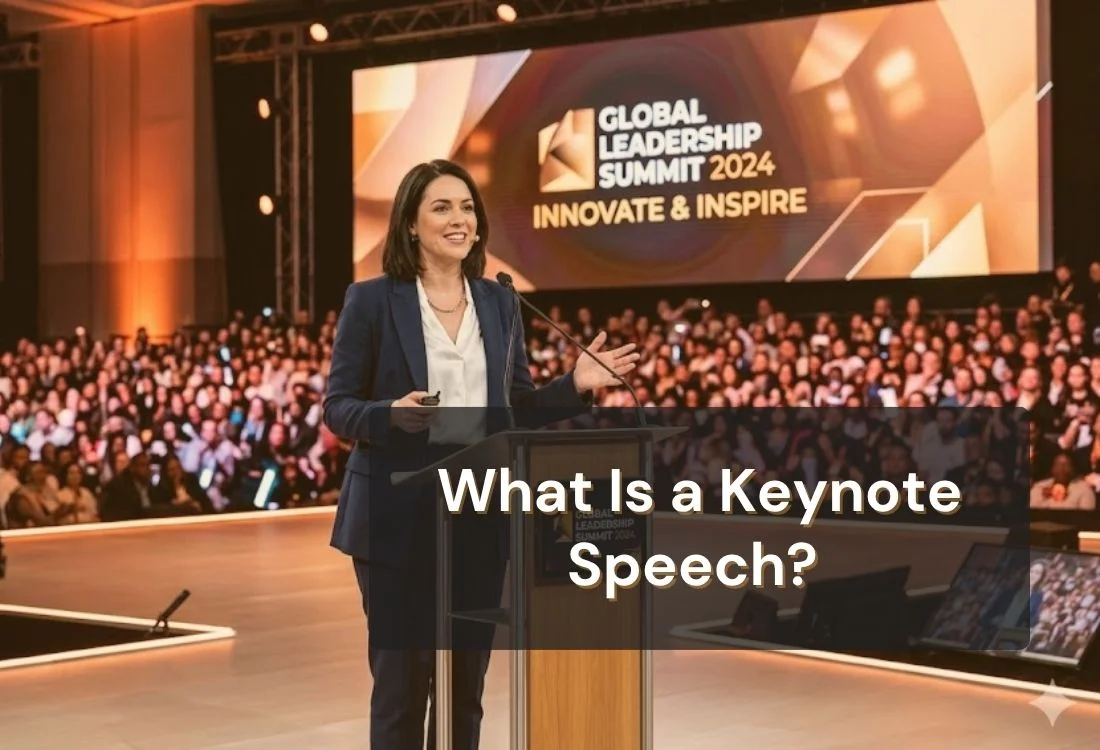


A keynote speech (also called a keynote address) is the main talk at an event. It introduces the central theme, aligns the audience around one clear message, and builds momentum for everything that follows. Keynotes are broad and story-driven, not detailed training sessions, and they typically run 20 to 45 minutes. A strong keynote opens with a clear hook, follows a simple structure, and ends with one takeaway people can repeat.

A keynote speech is the featured address at a conference, corporate event, or seminar that establishes the event's central theme. It is often delivered at the opening to frame the day's agenda, or at the close to unify what attendees experienced.
"Keynote address" and "keynote speech" are used interchangeably. Merriam-Webster defines a keynote address as "the principal address to a gathering" and it is also called "keynote speech." The root idea is simple: the keynote is the key note, the central idea everything else in the program connects back to.
Unlike a technical presentation or a workshop, a keynote focuses on the big picture. It gives the audience a shared perspective before they break into sessions and a unified takeaway when the program ends.

The purpose of a keynote address is to unify an audience around one central idea and create momentum for the event. A well-crafted keynote clarifies why the topic matters, sets expectations for what attendees will gain, and leaves the room with a message they can repeat and act on.
For event organizers, a strong keynote does more than open the program—it shapes how attendees perceive the entire experience. Research from Bizzabo's Event Marketing 2020 report shows that 95% of marketers believe in-person events have a significant impact on achieving primary business goals, reinforcing the strategic importance of well-designed event experiences and content strategy.
This underscores why keynote content is treated as a core part of event success rather than just a speaking slot. In fact, modern event strategy increasingly positions content and experience design as key drivers of engagement, with Bizzabo reporting that experiential learning and high-quality event design are considered important by the vast majority of organizers.
A keynote also creates shared language across the audience. Quotes, frameworks, and stories from a keynote become the common ground that drives hallway conversations, social media posts, and follow-up actions—extending its impact well beyond the stage.
Keynote speeches appear at different moments in an event, each with a distinct job.
Each type follows the same core structure: one clear idea, story-driven delivery, and a single repeatable takeaway.
A keynote is often confused with other presentation formats. Knowing the difference helps speakers prepare the right content and helps organizers set the right expectations.
A keynote is not a workshop. If your talk includes step-by-step instructions, live demos, and time for practice, it belongs in a breakout or training slot. A keynote does not go that deep. It goes wide.
A keynote is not a company update. Even in corporate settings, a keynote needs a unifying idea beyond quarterly numbers and product announcements.
A great keynote speaker can hold a room of 500 people through a single idea and leave every person with the same clear takeaway. That requires more than expertise. It requires clarity, structure, and stage presence.
Research shows that attention in presentations drops significantly after about 10–20 minutes if the content is not engaging or structured for retention. This is one reason many modern keynote formats, including TED-style talks, are intentionally designed to stay concise and focused.
The strongest keynote speakers share four qualities:
Speaking coach Patricia Fripp emphasizes that effective presentations require clarity, structure, and audience-focused messaging, as outlined in her speaking principles at Frippicisms. She teaches that speakers must refine and tighten their language so the audience remembers what matters most, rather than overwhelming them with excessive information or complexity.
Choosing the right keynote speaker starts with one question: what should attendees walk away thinking, feeling, or doing? If you can answer that clearly, it becomes much easier to evaluate speakers.
Watch clips of past talks and look for clarity of message, pacing, and how they handle a large, mixed audience. Speaker bureaus, peer recommendations, and online video archives are reliable starting points.

A keynote that lands well is not improvised. It is built around a clear structure and rehearsed with intention. For a full guide on crafting your speech from scratch, read how to write a keynote speech.
Here is the core framework:
Earn attention in the first 30 seconds. Strong openings include a short story that connects directly to your theme, a bold statement you will support with evidence, or a shared truth that makes the audience feel seen.
Avoid long introductions, extended thanks, and reading your own resume aloud. Credibility can be established in one sentence.
The clearest keynotes have a single premise. Every story, statistic, and example in the talk connects back to that one idea. If you can say "this talk is about [one thing]" clearly, you have your anchor.
Stories turn abstract ideas into something people can picture and remember. Use personal anecdotes, real-world case studies, or examples that match the audience's context. Specific details make stories credible.
Give the audience something they can actually use: a framework, a phrase, a next step, a fresh perspective. The takeaway is what gets shared after the event ends.
Do not end with "so, in conclusion..." or a recap of your bullet points. Close by returning to your opening story, delivering your core message one final time, and leaving the room with a clear call to action.
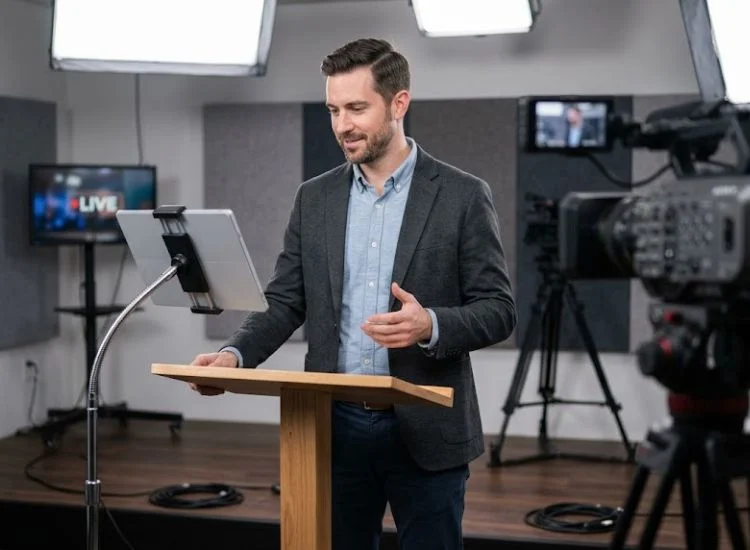
Writing a strong keynote is half the job. Delivery is where most speakers lose or win the room.
The biggest challenge for keynote speakers is not forgetting words. It is the mental load of trying to remember the next section while still speaking in the current one. That divided attention kills presence.
Professional speakers and executives use a teleprompter to stay fully present. Rather than relying on slides or memorized lines, they use a scrolling script to maintain eye contact, control pacing, and deliver precise language exactly as written, including statistics, product names, and transitions.
Teleprompter.com for keynote speakers is available on web, iOS, Android, and macOS. It works in any browser with no installation required, and supports multiple scroll modes so you can control speed by voice, fixed pace, time target, or words per minute.
Teleprompter.com users who present keynotes regularly report the same result.
"This app has been wonderful for presenting my keynote talk," wrote azmarina in a February 2026 App Store review. "Couldn't do it without it. Easy to use. Highly recommend."
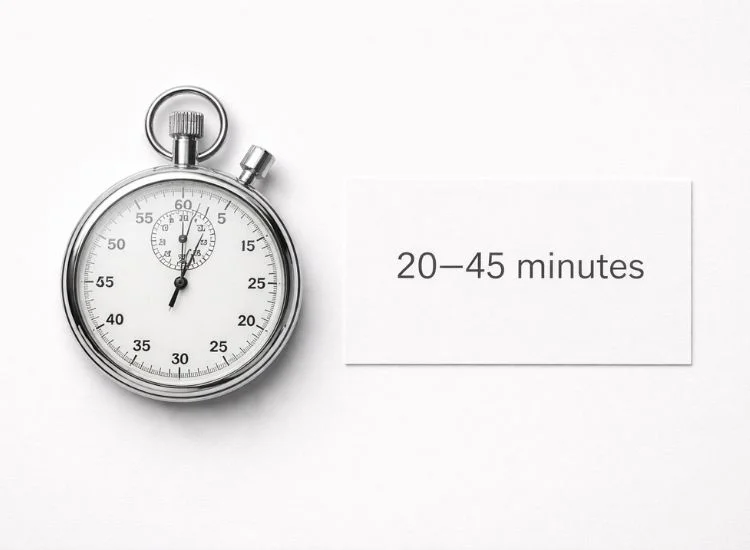
Most keynote speeches run 20 to 45 minutes. The right length depends on the event format and audience context.
The goal is not to fill the time. It is to use only the time you need. A keynote that ends at the 25-minute mark with a clear message and strong close is stronger than one that runs 40 minutes because the speaker kept adding "one more thing."
For a broader context beyond keynotes, see a complete overview of speech types.
Well-known keynote addresses show how powerful this format can be when a speaker commits to one clear idea.
Each of these keynotes succeeded for the same reason: one idea, told well, to the right audience.
A keynote is often the thing attendees talk about weeks after an event. It is the moment that frames how people experience and remember everything else on the agenda.
For organizers, a well-chosen keynote speaker raises attendance, media interest, and post-event engagement. A weak keynote, by contrast, can undermine sessions that follow it, no matter how strong those sessions are.
For speakers, the keynote is an opportunity to build credibility, advance ideas, and leave a lasting impression with a large audience. The speakers who do it best treat the keynote not as a performance to get through, but as a message to deliver.
The message matters. So does the delivery. Teleprompter.com helps keynote speakers maintain natural eye contact, stay on message, and control pacing without losing presence on stage.
Ready to Take the Stage? Teleprompter.com helps keynote speakers deliver every word with confidence, on any device, in any browser. See everything included in each plan and find the right fit for how you present. View plans and pricing.
A keynote address is the featured speech at a conference, seminar, or corporate event that introduces or reinforces the event's central theme. It sets the tone for the program and gives the audience one unified message to carry through the day. "Keynote address" and "keynote speech" are used interchangeably; "address" is simply the more formal of the two terms.
A keynote address and a keynote speech are the same thing. Both terms describe the featured talk at an event that frames the central theme. "Keynote address" is often used in more formal contexts. Merriam-Webster defines both as the principal address to an assembly.
A keynote speech addresses the entire audience around one broad, theme-setting idea. A regular presentation focuses on a specific topic, process, or data set and typically goes deeper on a narrower subject. Keynotes inspire and unify; presentations inform and instruct.
Keynote speakers are typically industry leaders, executives, researchers, founders, professional speakers, or public figures chosen for their credibility and fit with the event's theme. The right speaker is less about fame and more about relevance to the specific audience.
Prepare a keynote by identifying one central idea, building a simple three-part structure (open, middle, close), developing stories that support the central message, and rehearsing for pacing and timing. Many speakers use a teleprompter app to maintain eye contact and control delivery during the actual presentation.
Most keynotes run 20 to 45 minutes. Corporate events typically land at 20 to 30 minutes, conferences at 30 to 45 minutes, and virtual events at 15 to 25 minutes. The goal is to use only the time your message needs, not to fill the slot.


.png)


.png)


