

A keynote speech can do more than fill time on a conference agenda; it can shift perspectives, motivate change, and spark action. Writing one that truly connects takes clarity, authenticity, and emotional rhythm.
You’ll learn how to define a single message, build a clean keynote structure, and apply proven public speaking and speech writing techniques. The goal is a talk that feels human, stays focused, and holds attention from the first line to the final word.
A keynote speech is the anchor of an event. It establishes the mood, brings the audience together around one main topic, and often decides how people will remember the whole event. A keynote is different from a regular corporate presentation or lecture because it includes storytelling, insight, and leadership.
Every good keynote is built on three main ideas:
To structure your talk, focus on developing a solid keynote structure: a strong opening, a logical flow of ideas, and a meaningful conclusion that reinforces your message. When written and delivered well, your keynote can turn simple insights into moments that stick.
Every great keynote has one main idea that people remember long after the clapping stops. Think of it as the pulse of your speech.
Before writing a single line, ask yourself: If the audience remembers only one thing, what should it be? That single statement becomes your guiding light. It’s what ties together your stories, statistics, and transitions.
Take Steve Jobs’ 2005 Stanford commencement address as an example. His message wasn’t about technology, it was about connecting the dots in life. Every story, from dropping out of college to being fired from Apple, supported that one message.
Try this quick method to define your theme:
For instance:
“Innovation starts when curiosity meets courage.”
That becomes your speech’s north star. Every anecdote and insight should lead back to it.
Once you’ve chosen your core message, align it with the event’s goals and audience expectations. A keynote for entrepreneurs will differ from one for educators or healthcare professionals. Understanding who’s listening helps shape not just what you say, but how you say it.
Here’s a quick checklist to guide message alignment:
The best presentation tips often begin here: write for your listeners, not for yourself. When your message matches the room’s purpose, connection follows naturally.

A powerful keynote speech doesn’t start with writing—it starts with understanding. Before crafting sentences, take time to know who you’re speaking to. The more you understand their motivations, challenges, and expectations, the easier it becomes to create an authentic connection. As Toastmasters International puts it in their Know Your Audience guide, “If you can relate to your audience, they will relate to you.”
Every audience listens for a reason. Corporate professionals might seek inspiration to lead better. Students could crave reassurance or direction. Nonprofits may look for purpose and shared values. Identifying these needs allows you to tailor your message, tone, and examples.
Ask yourself:
For instance, an audience of entrepreneurs might respond well to lessons about risk-taking and innovation, while educators might connect more deeply with perseverance and community-building.
Great speakers adjust their tone the way musicians adjust pitch, depending on the room. A formal event calls for refined phrasing and structured rhythm, while a startup conference invites energy and conversational delivery. The trick is to sound human but intentional.
Use language that reflects how your audience communicates:
This balance of tone and phrasing turns effective speech writing into memorable communication.
Before finalizing your draft, gather insights about your audience:
These details may seem small, but they shape how you connect emotionally and intellectually. The best public speaking professionals spend as much time researching their audience as they do rehearsing their lines.
Once you fully understand who you’re addressing, your words start to feel like a conversation instead of a lecture. That’s the foundation of connection, the essence of an inspiring keynote.
The first 60 seconds of your keynote determine if your audience leans in or tunes out. A strong opening goes beyond enthusiasm, it must immediately feel relevant and meaningful to those listening.
Start with something your audience feels: a brief story, a personal moment, or a powerful question that sparks reflection.
Stanford Graduate School of Business professor Jennifer Aaker has said that stories are remembered up to 22 times more than facts alone, which helps explain why a well-chosen anecdote often stays with listeners longer than a list of statistics.
Effective opening ideas:
A story creates emotional investment. It sets the tone, builds trust, and invites your audience to see themselves in your message.
Generic greetings and predictable jokes can lose your audience before you begin. Phrases like “It’s great to be here today” or “I’m honored to speak to you all” may sound polite, but they don’t spark curiosity.
Instead:
Here’s an example of an engaging start:
“Three years ago, I almost walked away from my career. What I learned that day reshaped how I lead—and why I’m here to talk about courage.”
This kind of opening pulls listeners in instantly, establishing emotional credibility before logic even takes the stage.
A compelling introduction comes from speaking with authenticity and confidence. Your opening lines should immediately signal to the audience that your message is genuine and worth their attention.

Once your audience is listening, your next task is to keep them engaged. A keynote isn’t just a collection of ideas, it’s a narrative journey. Every section should lead smoothly to the next, building both logic and emotion. This balance turns your talk from informative to unforgettable.
The most effective keynote structure follows a pattern that mirrors human attention:
One practical structure to follow is the Problem–Insight–Action–Impact framework:
This approach maintains interest and emotional engagement.
Emotion drives memory. Facts create credibility. The best keynotes blend both seamlessly. Too much emotion without structure feels unfocused; too much logic without feeling feels sterile.
Here’s how to maintain balance:
For example:
“We chase success like it’s a finish line. But the truth? Success isn’t an end—it’s a pattern of courage repeated every day.”
The emotional rhythm here keeps listeners connected while reinforcing clarity.
Repetition helps key ideas sink in without feeling redundant. Strategic callbacks—revisiting a phrase, story, or metaphor later in the talk—tie everything together. Think of it as thematic glue that keeps your message cohesive.
For instance, if your opening story included a challenge, refer back to it near the end:
“When I stood on that stage years ago, I didn’t realize the moment would teach me what true leadership meant.”
This technique creates emotional continuity and reinforces your message naturally.
Even the best-written keynote can lose power if pacing feels rushed or uneven. Practicing with a teleprompter app helps control tempo, refine timing, and maintain consistent eye contact with your audience.
Apps like Teleprompter.com allow you to:
It’s one of the most practical presentation tips for achieving a confident and natural flow.
For a closer look at how rhythm and tone influence engagement, see the guide on speech patterns, it explains how pacing, pauses, and emphasis help shape memorable delivery.
A powerful closing brings your keynote to a meaningful finish, leaving your message resonating with the audience. It’s the moment to connect emotion to action, reinforcing your theme and inspiring reflection in a natural, authentic way.
A strong conclusion doesn’t rehash what you’ve said; it reframes your message with clarity and emotion. Instead of summarizing your entire speech, focus on bringing your audience back to your central idea in a way that feels earned.
For example, if your speech centers on the power of curiosity, your close could sound like this:
“Curiosity isn’t a question—it’s a commitment. It’s the choice to stay open, to keep asking, and to see the world not as it is, but as it could be.”
This reinforces the message without restating points, allowing listeners to walk away with a clear, emotionally charged takeaway.
Tips for an effective closing:
A deliberate pause often carries more weight than applause, giving your audience a moment to absorb and reflect on your words.
When your audience leaves the room, they shouldn’t just recall your topic; they should feel the energy of what you said. Great speakers achieve this through emotional closure and forward-thinking perspective.
Consider ending with:
For instance:
“Every great change begins with one small decision to speak with purpose. Make yours today.”
This kind of closing gives your audience ownership of the message. It moves them from passive listeners to active participants in the idea you’ve shared.
Writing a keynote speech is half the work—the other half is refining and delivering it effectively. Editing and practice transform good writing into compelling communication.
Editing is less about shortening your speech and more about refining its clarity. As you review your draft, consider these questions:
Simplify phrases that sound overly complex on paper. A speech confidence analyzer can also help highlight weak phrasing and filler words that may reduce impact when spoken aloud. Keynotes are meant to be heard, not read. Use conversational tone, direct language, and intentional pauses to improve rhythm and understanding.
Rehearsing aloud helps you internalize flow and emotion. Record yourself, then listen back to catch filler words, awkward transitions, or rushed pacing.
Here are a few practical public speaking tips during rehearsal:
With enough rehearsal, your delivery will sound spontaneous even when perfectly structured. That’s what separates strong speakers from memorable ones.
As you practice, explore the four methods of speech delivery (manuscript, memorized, impromptu, and extemporaneous) to find the approach that best fits your speaking style.
Seeing how a keynote comes together in structure helps transform theory into practice. Below is a simplified framework for a 15–20 minute keynote, showing how each section builds on the previous one while maintaining focus on a single message.
1. Opening (2 minutes)
Begin with a relatable story: a time you misunderstood a situation because you were too focused on responding rather than listening.
Transition into the main idea: “That moment taught me that leadership isn’t about speaking first—it’s about hearing what others need.”
2. Message Development (10 minutes)
Each section should naturally connect back to the central idea: effective leadership begins with authentic communication.
3. Closing (3 minutes)
“The next time you lead a conversation, pause long enough to listen—because that’s where real leadership begins.”
This structure creates a full-circle moment, making your speech both memorable and meaningful.
You can adapt this same model to any topic or event, just replace the examples with your own experiences and insights. The key is consistency: a clear idea, supported by emotion, delivered with precision.
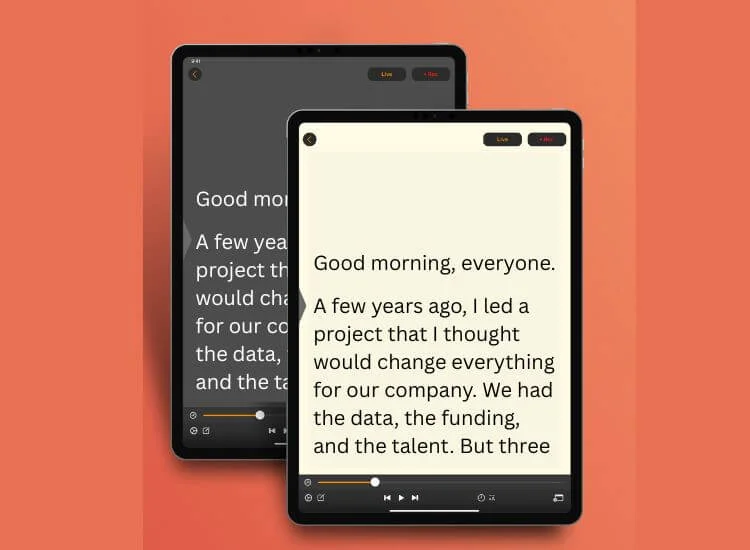
Teleprompter.com helps you achieve that polished, natural delivery through smooth pacing, consistent rhythm, and better engagement.
Using a teleprompter app allows you to focus on your audience instead of your notes, ensuring every word lands with intention. It also helps eliminate nervous pauses or rushed delivery, giving your speech a confident and professional finish.
Here’s how Teleprompter.com app can elevate your presentation:
Writing a keynote speech that truly inspires and connects takes strategy, self-awareness, and empathy. It’s about crafting a message that reflects both purpose and humanity—and presenting it with confidence and heart.
The process becomes far easier when you follow a clear structure:
With practice, your keynote can move beyond words—it can leave an imprint.
Start refining your delivery today with Teleprompter.com, the easiest way to rehearse, time, and perfect your keynote for any audience.
Most keynote speeches last between 20 and 45 minutes, depending on the event format and audience engagement.
A keynote speech sets the event’s main theme, inspiring and aligning the audience through storytelling, insights, and emotional connection.
Begin with a story, question, or strong statement that captures attention and introduces your main theme naturally.
Authenticity, clear structure, emotional storytelling, and a powerful takeaway make a keynote speech engaging and memorable.
Use a clear flow: strong opening, key ideas supported by stories, and a closing that reinforces your main message.


.png)


.png)


