Informative speech topics work best when they teach the audience something specific in a limited window of time, usually five to ten minutes. The right topic balances three things: enough research material to fill the time, a scope your audience can follow without background knowledge, and a subject you can explain with confidence.
What Makes a Good Informative Speech Topic
Three factors decide whether a topic works for an informative speech. Get any one of them wrong and the speech falls flat, no matter how well you deliver it.
Audience relevance matters most. A topic that fascinates you but means nothing to your listeners will lose the room in the first minute. Match the subject to what your audience already cares about or needs to know.
Researchability comes next. You need enough credible, current information to support five to ten minutes of content. Topics with only a few sources, or ones where the facts are contested, make weak choices for a purely informative format.
Appropriate depth rounds out the list. A topic like "how the internet works" is too broad for a short speech. A topic like "how a specific HTTP request travels from browser to server" is appropriately narrow. Good informative speech topics sit in that middle zone: focused enough to cover fully, broad enough to matter.
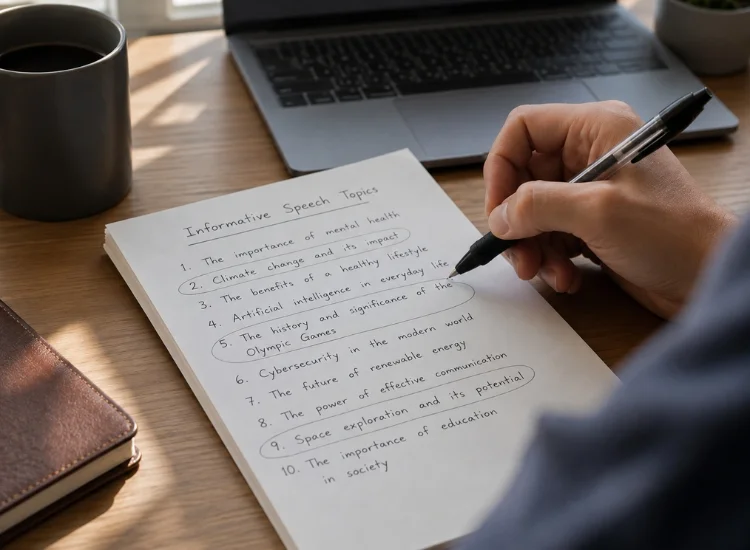
The topics below are grouped into nine categories so you can jump straight to the subjects that fit your audience. Each one is scoped for a five to ten minute speech, though you can narrow any topic further if you have less time.
Science & Technology
How CRISPR gene editing works
The rise of quantum computing
How self-driving cars make decisions
The science behind vaccines
How 5G networks function
The basics of blockchain technology
How solar panels convert sunlight into energy
The history of the internet
How artificial intelligence learns from data
The physics behind black holes
How 3D printing works
The science of sleep and the brain
Health & Wellness
The link between gut health and mood
How intermittent fasting affects the body
The science of stress and cortisol
How vaccines build immunity
The basics of mental health first aid
How sleep cycles affect memory
The impact of screen time on eyesight
How exercise changes brain chemistry
The role of hydration in physical performance
How the immune system fights infection
The rise of telehealth and virtual care
Understanding food allergies and intolerances
Business & Careers
How remote work is reshaping company culture
The basics of personal branding
How to build a professional network from scratch
The rise of the gig economy
How salary negotiation actually works
The basics of workplace emotional intelligence
How company mergers affect employees
The role of soft skills in career advancement
How to read a company's financial health
The basics of supply chain management
How artificial intelligence is changing hiring
History
The causes behind the fall of the Roman Empire
How the printing press changed the world
The history of the Silk Road
The women who shaped the civil rights movement
How ancient Egypt built the pyramids
The history of the Olympic Games
How the Cold War shaped modern geopolitics
The origins of common English idioms
How the Industrial Revolution changed daily life
The history of space exploration
How ancient civilizations tracked time
Environment & Sustainability
How recycling actually works
The basics of renewable energy sources
How climate change affects ocean currents
The impact of fast fashion on the environment
How urban gardens improve city life
The basics of composting at home
How deforestation affects global weather patterns
The rise of electric vehicles
How plastic pollution reaches the ocean
The basics of a circular economy
Arts & Culture
How jazz music shaped American culture
The history of street art and graffiti
How film editing shapes storytelling
The origins of classical ballet
How social media changed the art world
The history of graphic design
How museums preserve historical artifacts
The rise of independent filmmaking
How music genres evolve over time
The influence of mythology on modern storytelling
Education
How the Montessori teaching method works
The basics of project-based learning
How online learning platforms are changing education
The history of standardized testing
How bilingual education benefits the brain
The basics of adult learning theory
How gamification improves classroom engagement
The rise of homeschooling
How libraries are evolving alongside technology
The basics of special education services
How mentorship shapes career development
Social Issues
The basics of universal basic income
How social media affects teen mental health
The impact of the digital divide on education
How affordable housing shortages affect cities
The basics of criminal justice reform
How food deserts affect community health
The rise of remote healthcare access
How income inequality affects social mobility
The basics of immigration policy
How aging populations affect healthcare systems
The impact of automation on the job market
Psychology & Human Behavior
How habits form and why they're hard to break
The basics of cognitive bias
How memory actually works
The psychology behind procrastination
How social media affects self-esteem
The basics of emotional intelligence
How group dynamics influence decision-making
The psychology of first impressions
How fear and anxiety affect the brain
The basics of motivation and goal-setting
How color psychology influences perception
The science of happiness and well-being
Pro Tip: Pick a topic just outside your audience's existing knowledge
A topic your audience already knows well will bore them. A topic too far outside their experience will lose them. Aim for the middle: something they've heard of but don't fully understand. Before you commit, try outlining your speech with Teleprompter.com's AI script generator, to see how much material the topic actually gives you. If the outline feels thin after a few minutes of work, the topic is too narrow. If it sprawls into five different directions, it's too broad.
How to Narrow Down Your Topic Choice
Picking one topic from a list of 100 comes down to three questions.
Do I already know enough to speak on this confidently? You don't need to be an expert, but you should understand the basics before you start researching. A topic that requires you to learn everything from scratch eats into your prep time.
Can I explain this fully in five to ten minutes? If the honest answer is no, narrow the topic. "How the immune system works" is too broad. "How a fever helps your immune system fight infection" is the right size.
Will this specific audience care? A room of engineers and a room of new parents need different topics, even if the general subject overlaps. Adjust the angle, not just the topic, to fit who's listening.
Informative Speech Topics for Specific Situations
Some topics work better in certain settings than others. Here's how to match a topic to your specific audience.
Topics for College Students
Classroom presentations reward topics with academic depth and credible sources: the psychology of procrastination, the history of standardized testing, or how social media affects self-esteem all give you plenty of peer-reviewed material to draw from.
Topics for Adults & Professionals
Workplace and community presentations favor practical, career-relevant subjects: salary negotiation, workplace emotional intelligence, or the basics of supply chain management connect directly to what a professional audience deals with day to day.
Topics for Beginners
If this is your first speech, choose a topic with a low research burden and a simple structure: how recycling works, the basics of composting, or how habits form all give you a clear beginning, middle, and end without requiring specialized knowledge.
Category
Best For
Example Topic
Research Difficulty
Science & Technology
Advanced or technical audiences
How CRISPR gene editing works
High
Health & Wellness
General audiences, workplace wellness talks
How sleep cycles affect memory
Medium
Business & Careers
Professional and workplace settings
The basics of personal branding
Medium
History
Academic and classroom settings
The history of the Silk Road
Medium
Social Issues
College and community audiences
The basics of universal basic income
High
Psychology & Human Behavior
First-time speakers, general audiences
How habits form and why they're hard to break
Low
From Topic to Delivery: What Comes Next
Choosing a topic is the first decision, not the last one. Once you've settled on a subject, the work shifts to structure and delivery.
The 2025 Chapman University Survey of American Fears found that only 33.7% of Americans report being afraid or very afraid of public speaking, well below more commonly assumed rankings. For most speakers, the bigger challenge isn't fear. It's staying on message and on time once they're actually in front of the room.
That's exactly the gap a script tool is built to close. Angel joy211, a Teleprompter.com user on the iOS App Store, downloaded the app just days before a scheduled speech and left this review: "I needed something that would display my script that I could read hands-free." Reviewed May 15, 2025, United States, App Store.
Start by writing a strong opening line that pulls your audience in before you get to the facts. The guide to speech hooks walks through openings that work for informative content specifically. Then build your speech around a clear structure, whether that's chronological, cause-and-effect, or categorical, so your audience can follow the logic from start to finish.
Practicing with a teleprompter app keeps you on script and on time without sounding like you're reading, so you can focus on tone and eye contact instead of memorizing every line. If nerves are part of the challenge, these strategies for overcoming stage fright with a teleprompter can help you settle in before you speak.
Ready to rehearse your speech without losing your place?
What are good informative speech topics for college students?
Topics with strong academic sourcing work best: the psychology of procrastination, the history of standardized testing, or how bilingual education affects the brain. These give you access to peer-reviewed research and clear structure.
How long should an informative speech be?
Most informative speeches run five to ten minutes. Classroom assignments often specify the exact length, so confirm your time limit before narrowing your topic.
What's the difference between an informative and a persuasive speech topic?
An informative topic explains facts without asking the audience to change their mind. A persuasive topic argues for a specific viewpoint or action. "How solar panels work" is informative. "Why your city should invest in solar energy" is persuasive.
What makes a topic too broad or too narrow for an informative speech?
A topic is too broad if you can't cover it fully in your time limit, like "the history of medicine." A topic is too narrow if it can't fill more than a minute or two, like a single obscure fact. The right topic sits between the two.
Can an informative speech topic be personal, or does it have to be factual?
It can be both. A personal topic, like your experience learning a new skill, works as long as you present it with structure and factual support rather than persuasion or opinion.
How many topics should I consider before picking one?
Shortlist three to five topics you're genuinely interested in, then run each through the audience, research, and time-limit questions above. The one that passes all three is your best choice.
Recording videos is hard. Try
Teleprompter.com
Recording a video without a teleprompter is like sailing without a compass.









.png)


.png)