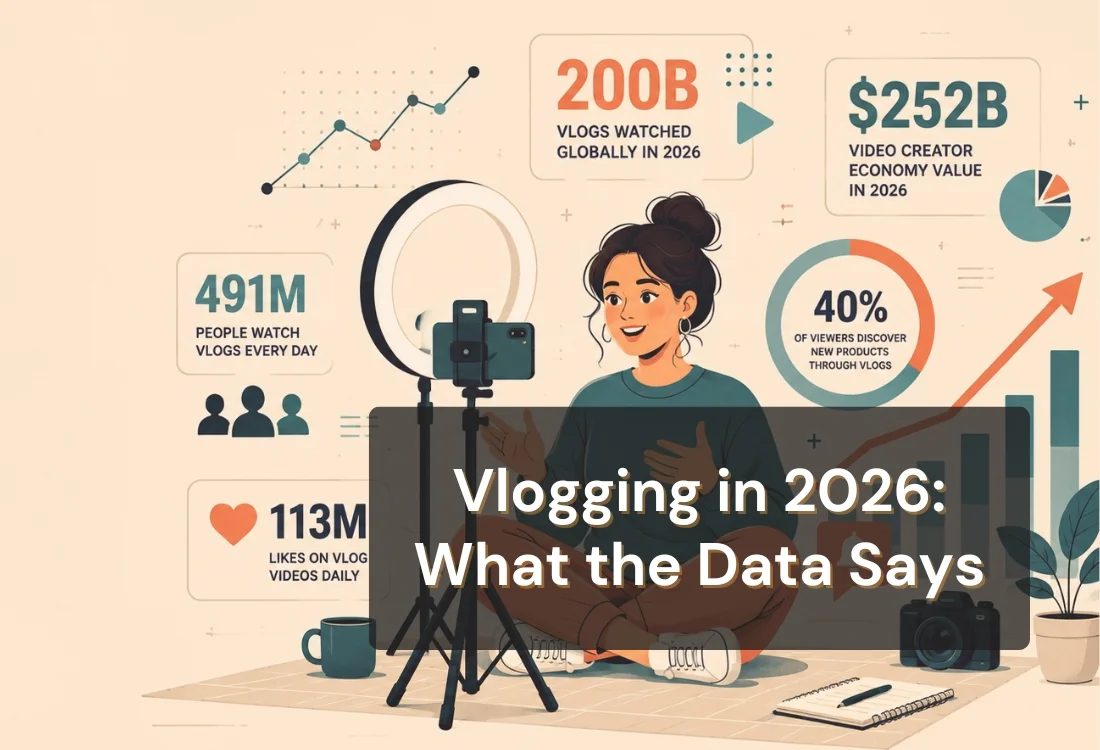


Vlogging in 2026 is bigger and more crowded than ever. YouTube has paid creators over $100 billion in four years,1 and the creator economy reached about $252 billion in 2025,4 yet roughly 9 in 10 channels never pass 1,000 subscribers.12 These vlogging statistics are current and fully sourced below, and each one reads back as a recording decision you can act on today.

Vlogging sits inside a creator economy worth about $252 billion in 2025.4 YouTube, the home turf for most vloggers, generated more than $60 billion in revenue that year, making it larger than Netflix,2 and its ad business alone brought in $40.37 billion, up 11.7% year over year.3
The knock-on effect is real money for creators. In 2024, YouTube's US ecosystem contributed $55 billion to GDP and supported more than 490,000 full-time jobs.1 Camera makers see the demand too: vlogging and social content was the single biggest use case for consumer mobile video cameras at 40% of that market in 2025, a market on track to grow from $8.5 billion to $25.93 billion by 2035.5
For a new vlogger, the signal is not “buy more gear.” Growth is fastest around lightweight, mobile-first setups, so you can start with the phone in your pocket and a browser-based prompter, then upgrade later. If you are still shaping your channel, the guide to vlog ideas for beginners is a good next stop. For platform-wide YouTube totals, see Teleprompter.com’s report on 2025 YouTube statistics.

There are more than 113 million YouTube channels, of which roughly 60 to 65 million upload at least monthly.11 Getting noticed is the hard part: only about 8.86% of channels have crossed 1,000 subscribers.12 Clear that mark and you are already in the top tenth of all channels.
Shares are directional, based on a widely cited channel-distribution dataset (circa 2022);12 exact figures shift over time.
The channels that break through share one habit: they publish consistently for at least 12 months without quitting. Consistency beats talent almost every time.

Earnings are driven by niche far more than by view count. Finance content runs a $15 to $50 CPM, while general lifestyle or entertainment sits at $2 to $8,9 a gap that reflects advertiser demand, not audience size. Geography is the other big lever: US audiences average around a $32.75 CPM,10 while some markets sit under $1.
CPM ranges are 2026 benchmarks;9 RPM reflects roughly the 55% share creators keep after YouTube's cut and unfilled impressions.
YouTube Shorts now average 200 billion daily views,1 following a roughly 186% jump in a single year.6 The catch is pay: long-form earns far more per view. Shorts RPMs stay under $0.20 against $3 to $6 for long-form,7 and benchmark data pegs the gap at roughly 20 to 30 times per 1,000 views.8
Figures reflect creator-reported benchmarks.78
Use Shorts for discovery, not income. Post them to get found, then convert that attention into long-form watch time where the ad money lives. If Shorts are part of your plan, our guide on how to go viral on YouTube Shorts breaks down the format.
A strong vlog holds 50% or more of its audience, but most land between 30% and 45% average view duration. Retention drops hardest in the first 30 seconds, and roughly 70% of YouTube watch time comes from recommendations rather than search. That makes your opening the most valuable few seconds you will edit.
Ranges reflect common creator benchmarks; your own numbers depend on niche and audience.
India is YouTube's largest audience at 491 million users, ahead of the United States at 253 million. The biggest single age group is 25 to 34, at about 21.7% of users, and US viewers spend an average of 49 minutes a day on the platform.13
The bigger shift is where people watch. YouTube has led US streaming watch time for nearly three years, and viewers now watch more than a billion hours of YouTube on TV screens every day.
Your vlog now competes on a living-room television, not just a phone. Framing, lighting, and a steady read all matter more when the screen is 55 inches wide and the viewer is sitting back on a couch.

The data points to four moves: win the first 30 seconds, aim for 7 to 15 minutes, script to cut retakes, and shoot on the device you already own. Each one turns a benchmark above into a recording choice.
The 2026 numbers reward three things: consistency, long-form, and a strong open. The industry is richer than ever, but the odds are stacked against anyone who quits early or leans only on Shorts. The vloggers who win publish on a schedule, keep viewers past the 30-second mark, and spend less time on retakes and more on delivery.
That last part is where a prompter earns its place. Teleprompter.com is free to start, works on Web, iOS, Android, and macOS, and runs right in your browser, so you can read naturally and shoot in fewer takes from the first video onward.
There are more than 113 million YouTube channels, with 60 to 65 million uploading at least monthly. Only about 8.86% have crossed 1,000 subscribers, so reaching that mark already puts you in the top tenth of all channels.
Vlogging and general lifestyle content earns a $2 to $8 CPM, which nets roughly $1 to $5 per 1,000 views after YouTube's cut. Higher-value niches like finance pay several times more. Most full-time vloggers earn the majority of their income from brand deals, affiliates, and products rather than ads.
Shorts are excellent for discovery but weak for direct income. They average 200 billion daily views,1 yet pay roughly 20 to 30 times less per view than long-form. Use Shorts to grow your audience, then move viewers to long-form where the ad revenue is.
A retention rate of 50% or higher is strong for long-form vlogs, while most creators land between 30% and 45%. Retention falls fastest in the first 30 seconds, so a sharp hook matters more than any other edit. Holding viewers past that mark tends to earn wider recommendations.
For ad revenue, 7 to 15 minutes is the sweet spot. It clears the threshold for mid-roll ads while staying short enough to keep retention high. Videos under 5 minutes hold the most attention, but earn less per view.
Yes. The creator economy reached about $252 billion in 2025, YouTube ad revenue grew 11.7% year over year to $40.37 billion, and vlogging is the largest use case in the consumer mobile video camera market at 40% share. Competition is rising just as fast, which is why consistency and delivery quality now separate the channels that grow from the ones that stall.
References:
[1] From the CEO: What's coming to YouTube in 2026 (Neal Mohan, YouTube Official Blog, Jan 2026): $100B paid to creators; Shorts 200B daily views; #1 US streaming watch time per Nielsen; $55B GDP and 490,000 US jobs; YouTube Shopping.
[2] YouTube full-year 2025 revenue topped $60 billion (Variety, Feb 2026).
[3] YouTube ad revenue reached $40.37 billion, up 11.7% (Music Business Worldwide, Feb 2026).
[4] The creator economy is valued at $252.33 billion in 2025 (Grand View Research).
[5] Consumer mobile video camera market: vlogging 40% share, $8.5B to $25.93B by 2035 (Precedence Research).
[6] YouTube Shorts up 186% to 200 billion daily views (The Wrap, Cannes Lions 2025).
[7] Shorts RPM under $0.20 vs $3 to $6 long-form (Digiday).
[8] Shorts vs long-form revenue gap of 20 to 30 times (TubeAnalytics).
[9] YouTube CPM and RPM rates by niche (Lenos).
[10] US CPM $32.75; highest-paying niches (Upgrowth).
[11] 113M+ channels; 60 to 65 million active (DemandSage).
[12] 8.86% of channels have 1,000+ subscribers (Indiy, channel-distribution dataset).
[13] India 491M and US 253M users; 49 minutes daily in the US (SQ Magazine, citing DataReportal).


.png)


.png)