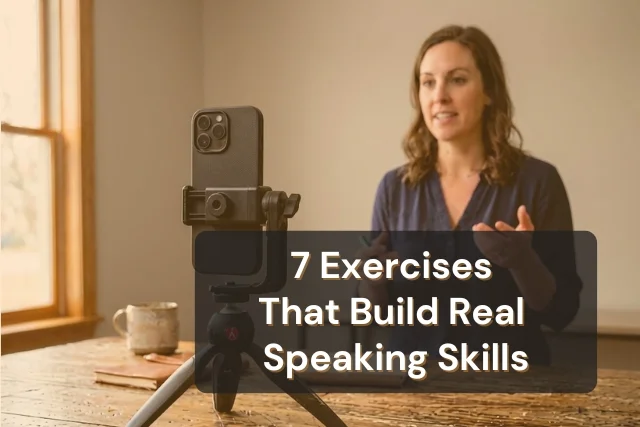


To practice public speaking at home, record yourself delivering a prepared script, review the playback critically, rewrite any section that trips you up, and repeat. That four-step loop, applied consistently with the right exercises, builds the muscle memory and delivery control that no amount of passive reading or mirror practice can replicate.
Most at-home practice stalls because it lacks a feedback mechanism. Reading your speech aloud feels productive. It rarely is. The 7 exercises below introduce real feedback at every stage, so each session moves you forward rather than just getting you through it.
Most people practice their speeches the same way they studied for exams: they read through the material again and again until it feels familiar. Familiarity feels like progress. In speaking, it is not.
Reading your speech aloud in an empty room can help you learn the words, but it removes two things that make real delivery difficult: pressure and feedback. There is no audience watching your pace, no camera capturing your expression, and no one pointing out the parts that sound unclear. You may finish the script and feel prepared, but that does not always mean you can deliver it well when it matters.
Research by Roediger and Karpicke on test-enhanced learning found that repeated studying can increase confidence, even when active retrieval leads to stronger long-term retention. In simple terms, rereading can make material feel familiar without proving you can recall it under pressure.
The same idea applies to speaking practice. Reading your script repeatedly can make the words feel comfortable on the page, but it does not prove you can deliver them clearly when the camera is on, your timing matters, or an audience is listening. Passive rehearsal builds a false sense of readiness. Structured practice shows you what still needs work.
The fix is a structured feedback loop called The Rehearsal Loop.
Every exercise below maps to at least one stage of this loop. Work through them in order and you will be practicing deliberately, not just putting in time.
Rehearsal Loop stage: Write
Most speakers start practicing before they have a clear structure. That means they spend most of their session figuring out what to say rather than how to say it. The two problems require different kinds of work.
Write your content down before you open your mouth. It does not need to be word-for-word unless you are delivering a formal speech. A clear outline with your opening line, three to five key points, a transition between each, and a closing statement is enough. That structure gives your brain something reliable to hold onto under pressure.
If the writing step is slowing you down, AI script generator produces a structured, conversational script from a topic or set of notes in under a minute. Use it as a starting draft and then edit it to sound like you.
For a deeper look at structuring a script for natural spoken delivery, read how to write a video script.

Rehearsal Loop stage: Record
This is the most important exercise on this list, and the one most people avoid.
Set up your phone or camera, press record, and deliver your full speech from start to finish without stopping. If you lose your place, recover and keep going. If you stumble on a word, push through. Do not restart the recording.
The reason this matters is behavioral. The habit of stopping and restarting is the exact habit that causes speakers to freeze on stage. Every time you hit record again, you are training yourself that stumbling means stop. On stage, there is no restart button. The One-Take Record teaches your brain to recover rather than collapse.
Do this at least twice per session. Your second take will almost always be noticeably better than the first, purely because the performance pressure of the first take has been metabolized.

Rehearsal Loop stage: Record
Most people think of a teleprompter as a filming aid. It is also one of the best pacing coaches available for at-home practice, and you do not need any hardware to use it.
Load your script into Teleprompter.com and run it in VoiceGlide mode, the app's voice-activated scrolling feature. As you speak, the text tracks your voice in real time, holding steady when you pause and continuing right where you left off. If you rush, the text stays with you. If you slow down, it slows with you. That live feedback trains one of the most important delivery skills: speaking at a controlled, consistent pace rather than speeding up when you feel nervous.
Using a teleprompter for practice also separates content retrieval from delivery work. When you are not spending mental energy trying to remember what comes next, you can focus entirely on how you are saying it: your eye contact, your pauses, your emphasis. That separation accelerates improvement faster than freestanding rehearsal.
The preparation step — having a script loaded and ready — is what makes that focus possible. Creators who use Teleprompter.com for practice sessions consistently report the same shift:
Note: if your primary challenge is on-camera anxiety rather than delivery skill, the companion article on overcoming stage fright on camera covers the psychological preparation side. This exercise addresses the skill side.
Rehearsal Loop stage: Review
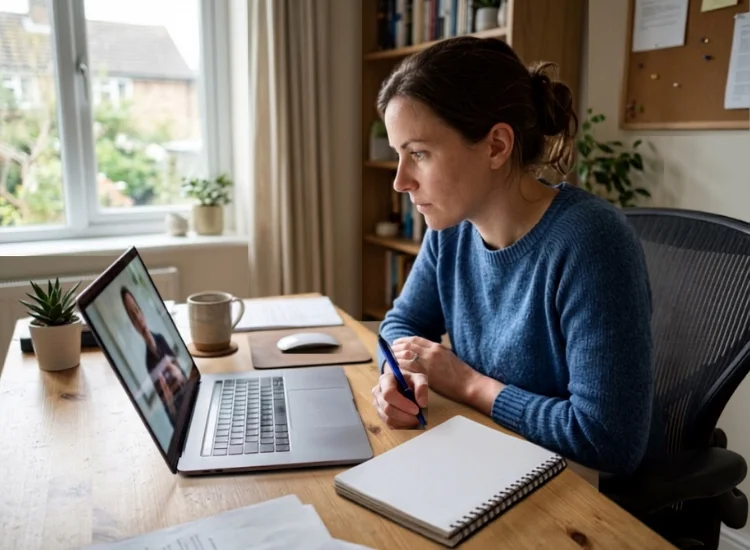
Recording yourself is only useful if you review the footage correctly. Most people watch their recordings and wince at their voice or their appearance. That is not a review. It is self-criticism with no actionable output.
The Silent Replay Review changes the input. Watch your recording back with the sound off first. When audio is removed, your visual delivery becomes impossible to ignore. You will see exactly how much you move unnecessarily, where your eye contact breaks, whether your hands distract or reinforce your words, and whether your facial expressions match what you are saying.
After the silent pass, watch with sound and listen specifically for filler words, pacing, and the moments where your energy drops. Most people find that discomfort with hearing their own voice fades quickly across sessions, and that the review becomes more analytical and less emotional the more consistently they do it. That shift from self-criticism to structured observation is the point.
What to look and listen for in each pass:
Rehearsal Loop stage: Record + Review
Monotone delivery is the most common sign that someone is nervous. When speakers are anxious, they default to a single pace and pitch because varying delivery requires spare cognitive capacity, and anxiety uses all of it.
Speed Variation Drills build that spare capacity in advance. Take a single passage from your speech (60 to 90 seconds is enough) and record it three times back to back:
Review all three recordings. The 80% version will almost always sound more authoritative and easier to follow than you expect. Most speakers discover they have been rushing their delivery by default. The 120% version reveals which phrases fall apart at speed, which usually means those phrases need to be simplified.

Rehearsal Loop stage: Record
The first 15 seconds of any speech carry a disproportionate amount of the anxiety. Heart rate is highest, the audience is forming its first impression, and the stakes of making a mistake feel largest. Most practice routines treat the opening as just another part of the script. It should be treated as a separate skill.
The Cold Open Exercise isolates your opening. Record it ten times in a row. No warm-up takes. Press record and start immediately, every time.
By the fifth take, the anxiety around the opening will be significantly reduced because your nervous system has experienced it enough times to recognize it as non-threatening. By the tenth take, you have the opening so well-practiced that nerves on the real day will not be enough to derail it.
This is different from over-rehearsing the full speech. You are not trying to memorize every word. You are specifically training the transition from silence to confident, clear delivery under pressure.
Rehearsal Loop stage: Rewrite
Before any recording session, read your full script out loud and mark every phrase that does not come out cleanly. If you slow down, stumble, or have to reread a sentence, circle it.
The rule is this: if a phrase trips you up twice in a read-aloud audit, rewrite the whole sentence, not just the word. Awkward phrasing at speed is almost always a structural problem, not a word-choice problem. A sentence that reads fine on screen often has a rhythm that your mouth cannot follow comfortably at speaking pace.
This exercise closes the loop. Every time you rewrite a tripped-up phrase and it flows cleanly in the next take, you have made the script better and your delivery easier. The Rehearsal Loop tightens with every pass.
The 7 exercises above do not all belong in the same session. A productive 20-minute session runs three or four exercises in a single loop, not all seven. Rotate focus across sessions rather than trying to improve everything at once.
Here is a practical weekly structure for someone preparing a speech or presentation:
For creators recording talking-head videos rather than preparing formal speeches, a shorter version of this loop (Write > Record > Review) works just as well, applied once per video rather than across a week.
Progress in public speaking is easy to underestimate because it does not feel linear. A session that goes badly is not evidence that you are not improving. But there are specific, observable signals that show your practice is producing real change.
Track these markers across sessions:
The difference between a speaker who improves and one who stagnates is feedback. Passive rehearsal feels like work. The Rehearsal Loop is work.
Write a structure you trust. Record a full take without stopping. Watch it back with the sound off first. Rewrite the phrases that tripped you up. Then do it again.
The seven exercises above give you the specific drills to build delivery range, eliminate filler habits, strengthen your opening, and make your pacing consistent under pressure. None of them require a coach, a classroom, or an audience. They require a phone, a structure, and the discipline to review honestly rather than just move on.
For more on building on-camera confidence alongside your practice, read our guide on content creator tips.
Twenty minutes of focused, structured practice is more productive than an hour of passive rehearsal. The key is quality of feedback, not volume of repetition. For high-stakes presentations, daily 20-minute sessions across five to six days will produce more measurable improvement than one long session the night before.
Yes. Recording yourself and reviewing the footage delivers the same feedback a live audience would, and in some ways more honest feedback. A camera does not laugh politely at weak material or nod encouragingly when your pacing is off. The key is structured review, not passive watching.
Recording is one of the highest-impact practice tools available, but only when paired with specific review criteria. Watching yourself and cringing is not useful. Watching with the sound off to assess body language, then listening back to identify filler words and pacing, converts footage into actionable data.
The most effective method is The Rehearsal Loop: write a clear script or outline, record a full take without stopping, review the footage with specific criteria, and rewrite any phrase that tripped you up. Repeat that cycle across multiple sessions rather than running through the whole speech repeatedly in a single sitting.
If your speech has a clear logical flow, each point cues the next naturally. Practice the structure first. If you are working from a full script, a teleprompter app removes the memory load entirely, letting you focus on delivery quality instead of content retrieval.
A teleprompter is particularly useful for building pacing discipline. Running a script through Teleprompter.com's VoiceGlide mode gives real-time feedback on whether you are rushing or dragging, which most speakers cannot detect accurately without an external reference. It also separates content recall from delivery work, which accelerates improvement.


.png)


.png)