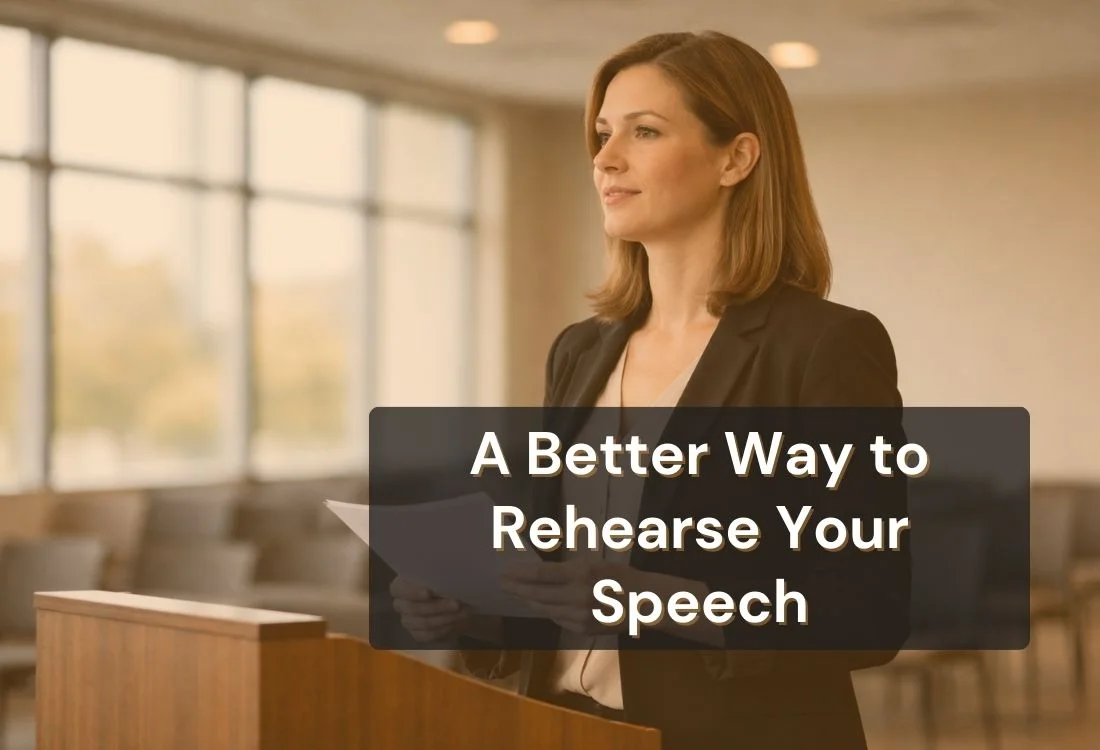


You wrote a great speech. You know your material. But the moment you start rehearsing, something feels off, you rush through sentences, lose your place, or sound like you're reading a grocery list. That gap between knowing your content and delivering it with confidence is exactly what structured practice is designed to close.
This guide walks you through how to practice for a speech the right way, whether you're preparing for a keynote, a boardroom presentation, a classroom lecture, or a YouTube video. You'll find practical speech rehearsal tips backed by research, a clear framework to follow, and tools to make every session count.
Most people "practice" a speech by reading through their notes silently, maybe once or twice, usually the night before. That approach trains your eyes, not your voice.
Fear of public speaking is far more common than most people admit. A study published in the Journal of Voice found that nearly 64% of college students report fear of public speaking, ranking it among the most prevalent anxieties in academic and professional settings (Marinho et al., 2017). Yet the solution isn't to memorize every word until you feel "ready." It's to build familiarity through deliberate, varied, and consistent practice.
The "out loud" gap is real: your brain processes written text very differently from spoken language. Practicing silently does not train your breath control, your mouth muscles, your pacing, or your ability to hold a thought across a long sentence. For that, you need to speak out loud, repeatedly, and in conditions that mirror your actual delivery environment.

Before you start rehearsing, run your script through three distinct reads:
This 3-read pass isn't a rehearsal yet. It's preparation for rehearsal. Skipping it means your first few practice sessions get wasted on edits that could have been caught earlier.
Trying to rehearse an entire speech from top to bottom in one go is inefficient. Instead, divide the script into logical sections, intro, three to five key points, and a close, and master each chunk before combining them.
Cognitive science refers to this as chunking: the brain stores and retrieves information more reliably when it's organized into grouped units rather than processed as one long sequence. Once individual sections feel solid, chain them together and run full end-to-end passes.
This cannot be overstated. How a speech sounds out loud is almost never how it reads in your head. Sentences that look clean on paper can become impossible to say without gasping for air.
Practicing out loud trains three things simultaneously: pacing, pronunciation, and physical comfort with the material. These do not develop through mental rehearsal alone. If you've only ever run through your speech in your head, your first real out-loud session will feel like a completely different speech.

Recording your practice sessions is one of the most effective and underused rehearsal techniques available. Video captures what mirrors miss: your posture, hand placement, facial expression, and whether you're making eye contact or staring at the floor.
When reviewing the playback, watch as if you're observing a stranger. Look specifically for:
Audio-only recordings are also useful for long commutes or off-screen review. The goal is external feedback on a performance that feels very different from the inside. If recording is part of your path toward full recall rather than just familiarity, memorizing a speech with a teleprompter app uses that same record-and-review habit as one of its core techniques.
The average natural conversational speaking pace sits between 130 and 150 words per minute. Under the pressure of live delivery, nervous speakers routinely climb above 180 wpm, which makes them harder to follow and signals anxiety to the audience.
Pacing too slowly is equally problematic; it loses attention and can come across as uncertain. The goal is deliberate, moderate pacing with purposeful pauses at the end of key ideas.
For more on managing pace during delivery, see this guide on how to stop speaking too fast.
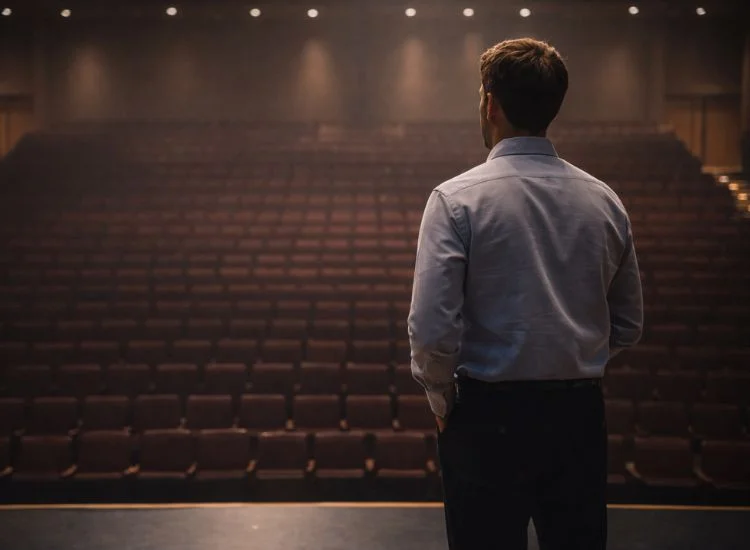
Rehearsing while seated at a desk is convenient. It's also misleading. Standing changes your breathing, your projection, and your physical presence in ways that seated practice simply cannot replicate.
Marjorie North, a public speaking consultant and contributor to Harvard's Professional Development blog, puts it plainly: the best way to overcome anxiety is to "prepare, prepare, and prepare some more," and that preparation has to be active, not passive.
Reading over notes at your kitchen table is not the same as standing up and performing under realistic conditions.
Whenever possible, practice in conditions that mirror your actual delivery setup:
If you can get into the room ahead of time, use it. Walk the stage. Look out into the empty seats. Touch the podium. Familiarity with a physical space reduces the novelty of being in it, and novelty is one of the most underappreciated drivers of performance anxiety. The more your brain has already processed the environment, the less cognitive load it carries on delivery day.
Most people don't have stage access in the days before a speech, though, and that's fine; you can build the same realistic pressure without leaving your living room. This guide on how to practice public speaking at home walks through exercises that simulate an audience, a venue, and real delivery conditions using nothing but the space you already have.
Your opening is the most important part of the speech. Audiences decide within the first 30 seconds whether they're going to lean in or mentally check out.
Practice your opening more than any other section. Test different versions. If you're opening with a statistic, a story, or a provocative question, make sure it lands with energy, not as something you're warming up to say.
Avoid the most common opening mistake: "Today, I'm going to talk to you about…" That line signals that you haven't thought about what your audience actually needs from you. For more on the fundamentals, see what public speaking actually is and the 5 Ps of public speaking.
One long rehearsal the night before a speech is one of the most common preparation mistakes. It feels productive, but it doesn't give the material time to settle. Your brain needs rest between sessions to consolidate what it's practiced, and that consolidation is what separates a speaker who knows their content from one who owns it.
Short, consistent sessions across multiple days are far more effective than a single cram. For a 10-minute speech, aim for 20 to 30 minutes of focused practice daily across five to seven days before delivery. Each session builds on the last, and the gaps between them are where retention actually forms.
Spaced practice also reduces the risk of blanking mid-speech. When you've rehearsed something across multiple days, the material is stored more deeply, so even under the pressure of a live audience, your recall is more reliable than it would be after one exhausting overnight session.
Before you rehearse a single word, run your script through the free Script Timer, so you're not drilling a 15-minute speech you think is 10.

Solo rehearsal builds fluency. Audience rehearsal builds confidence. They are different skills, and both are necessary.
Start with one person you're comfortable with. Ask them to note when you seem to rush, when you lose energy, or when a point is unclear. A simple feedback checklist helps: clarity, pace, eye contact, energy, and persuasiveness are five useful categories.
As you get closer to the delivery date, practice in front of a small group if possible. Even a mildly distracting environment, phones, side conversations, shifting seats, prepare you for the unpredictability of a live audience.
See this guide on how to prepare for public speaking for a broader preparation framework that complements rehearsal.
Over-rehearsal is a real problem. Once your speech is in strong shape, continuing to drill the same passages verbatim can strip out the natural variation in tone and phrasing that makes delivery sound human.
At a certain point, shift your focus from running the full script to practicing only the sections that challenge you. The goal is to sound conversational and confident, not to prove you've memorized a transcript. If you can hit every key point without reading verbatim, your preparation is working.
For context on why delivery matters so much, this piece on the importance of public speaking is worth a read.
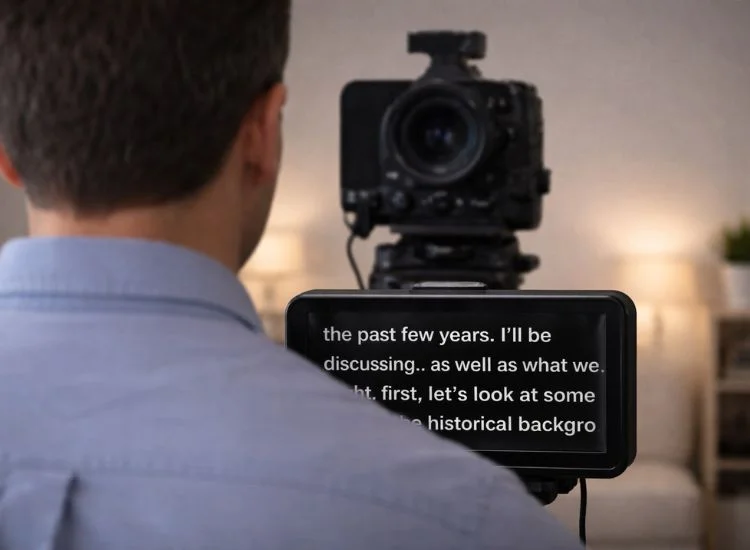
One of the most underrated public speaking practice techniques is rehearsing with a teleprompter. Most people think of teleprompters as tools for recording, but they're equally powerful as rehearsal aids.
Here's why it works: reading from paper forces your eyes down, breaking eye contact, and weakening your connection with the audience. A teleprompter keeps your script directly in your line of sight, training you to maintain a forward-facing presence while still following your prepared words. That habit, built during practice, carries over directly into live delivery.
Teleprompter.com lets you load your script, control scroll speed to match your natural pace, and rehearse on any device. It works offline, so you can practice backstage, on a flight, or anywhere you have a few minutes. You can section your script into chunks, adjust font size for comfort, and use Lexend or OpenDyslexic font options for more accessible rehearsal. For on-camera delivery, it's the closest practice environment to the real thing.
Still haven't settled on a subject? Working from a strong list of informative speech topics makes the rest of this process easier, since a well-scoped topic gives you a script that's actually rehearsable in five to ten minutes. If you haven't started your script yet, the AI Script Generator can help you draft one before you move into rehearsal.
For more on body language and physical delivery, check out this guide on hand gestures in public speaking.
Knowing how to practice for a speech is a skill in itself, and most people skip the steps that actually matter. They read silently, skip recording, rehearse sitting down, and cram the night before. None of that prepares the voice, the body, or the nerves for live delivery.
The framework that works: read your script aloud, break it into chunks, record every session, stand up, control your pace, simulate your environment, and build up to practicing in front of people. Do it over several days, not all in one night.
And when you're ready to rehearse with your script in front of you, without losing your eye contact or your place, load it into Teleprompter.com and rehearse like a pro.


.png)


.png)