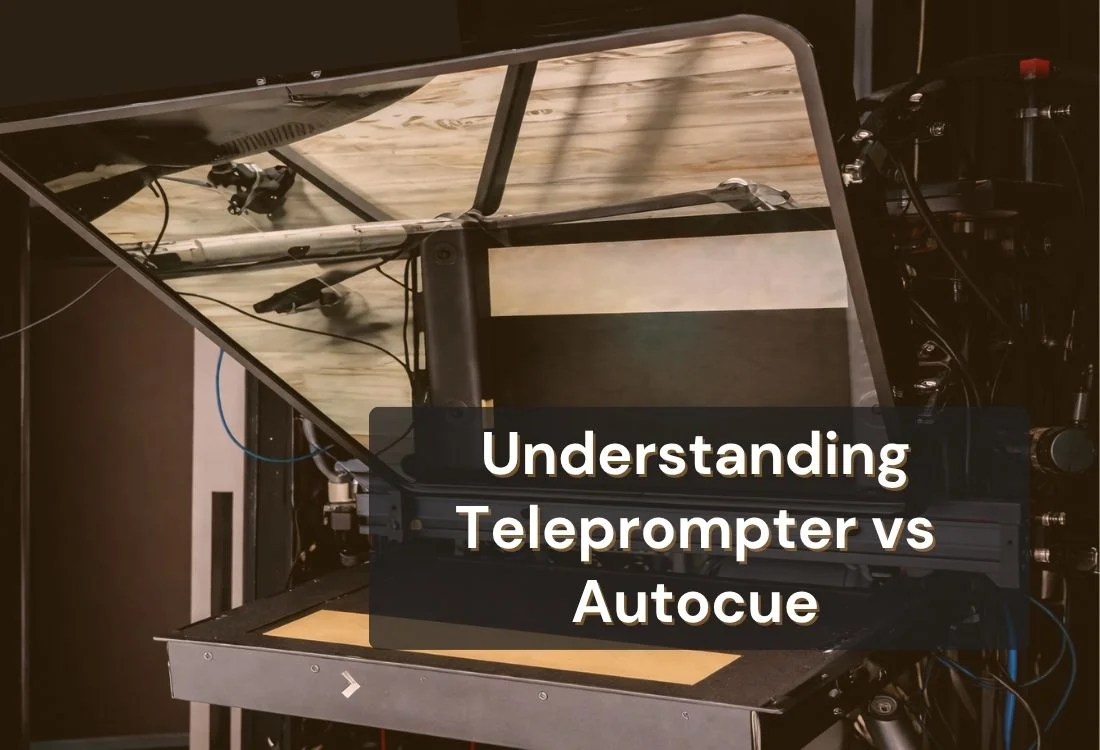


A teleprompter and an autocue are the same thing. "Teleprompter" is the American English term. "Autocue" is the British English term, widely used in UK broadcasting and European media. Both refer to a device or software that scrolls a script at a controlled pace for a speaker to read on camera.
This post breaks down where each term comes from, how both technologies work, and how modern software has made professional-grade script reading free for anyone.
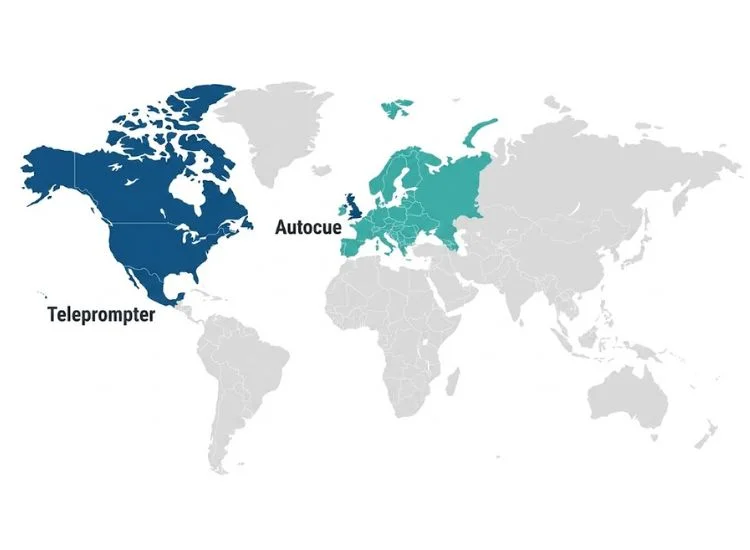
There is no functional difference. A teleprompter and an autocue do exactly the same job. They scroll a script at a readable pace so a speaker can maintain eye contact with the camera while delivering their lines.
The distinction is purely linguistic and regional. In the United States and most of the global content creation space, the word "teleprompter" is standard. In the United Kingdom, Ireland, Australia, and much of the broadcast industry internationally, the word "autocue" is used instead.
Think of it like "lift" versus "elevator," or "boot" versus "trunk." Same object, different words depending on where you are.

Both terms trace back to brand names that became generic, much the same way "hoover" became the everyday word for vacuum cleaner in Britain regardless of the manufacturer.
"TelePrompTer" was trademarked in the early 1950s by Hubert Schlafly and Irving Berlin Kahn, who developed the original scrolling-script device for television broadcasts in New York. The technology quickly became essential in US television studios, and the brand name passed into common use as the generic term. For a full look at how that technology developed over the decades, see the history of the teleprompter.
"Autocue" followed a parallel path in the UK. Autocue Ltd, a British company, became the dominant supplier to the BBC and other UK broadcasters from the 1950s onwards. Their brand name became synonymous with the technology itself across British and European broadcasting. Autocue Ltd is now part of QTV, but the generic term it left behind is still in everyday use in newsrooms from London to Sydney.
This parallel branding history explains why both words stuck so firmly in their respective regions. Neither is more accurate. Neither is more professional. They are equally correct descriptions of the same tool.
Both work on the same principle: text is displayed in front of the camera lens at a controlled scroll speed, so the presenter can read while appearing to look directly at the viewer.
In a traditional hardware setup, a half-silvered mirror or beam-splitter glass is mounted at a 45-degree angle in front of the camera lens. A screen positioned below the mirror reflects the scrolling text upward onto the glass. The camera shoots through the mirror without picking up the reflection. The presenter sees the text. The camera sees only the presenter.
Modern software solutions work the same way without any of the hardware. The script scrolls on a phone, tablet, or browser window positioned near or below the camera lens. The result for the viewer is identical: a speaker who appears to be talking directly to them.
For a practical breakdown of setup and technique, the guide to how to use a teleprompter covers positioning, scroll speed, and script formatting in detail.
The split comes down to when and where each group adopted the technology.
Professional broadcasting in the UK, Ireland, and Australia built its workflows around Autocue Ltd equipment from the 1950s onwards. The terminology embedded itself in the industry. Newsreaders, TV presenters, and broadcast journalists are trained on systems described as autocues. That language became part of professional practice and persists in broadcast education and newsroom culture today.
The global wave of digital video creation, driven by YouTube, podcasting, and online video platforms, has primarily been led from the United States. That content creator community adopted "teleprompter" as the default word, both in product names and in the way creators discuss their setup online. YouTube receives over 500 hours of video uploads every minute, with the majority of that production community based in or shaped by North American terminology. (Statista, Feb 2022)
If you work in UK television or broadcast journalism, calling it an autocue is correct and professional. If you are a content creator, YouTuber, or video producer anywhere in the world, calling it a teleprompter is equally correct. Anyone who tells you one term is wrong is applying regional convention, not technical fact.

The beam-splitter rig remains standard in professional broadcast studios. It is purpose-built for studio cameras, news desks, and anchored presenter formats where a dedicated autocue operator adjusts scroll speed in real time to match the presenter's delivery pace.
Outside of broadcast studios, software has almost entirely replaced hardware for most use cases. A smartphone, tablet, or laptop positioned close to the camera lens delivers the same eye-line effect at a fraction of the cost.
Modern software teleprompters also offer capabilities that traditional hardware cannot match. Teleprompter.com, for example, includes four distinct scroll modes: VoiceGlide (voice-activated scrolling), fixed speed, fixed time, and words-per-minute control. Scripts can be edited and shared in the cloud, and the app works across iOS, Android, macOS, and any web browser with no installation required.
For a broader look at how different types of equipment compare, see the four most common types of teleprompters and the teleprompter devices guide for every budget.
Use the term your audience or industry uses.
If you are producing or working in UK broadcasting, journalism, or European media, "autocue" is the correct professional terminology. It is what your colleagues, clients, and industry training materials will use.
If you are a content creator, YouTuber, podcaster, business professional, or video marketer operating in a global or North American context, "teleprompter" is the standard term. It is what apps, platforms, and online communities use.
If you are ever confused by someone else's usage, assume they mean the same thing. They almost certainly do.
Teleprompter.com offers a professional-grade script reading tool, completely free and accessible instantly on any device through your browser, no hardware or downloads needed.
Regardless of whether you call it a teleprompter or an autocue, get started now. Try Teleprompter.com free.
Yes. An autocue and a teleprompter are the same device. "Autocue" is the British English term, commonly used in UK and European broadcasting. "Teleprompter" is the American English term, used in North America and across global digital media. Both describe a device or software that scrolls a script for a speaker to read while looking at the camera.
Autocue is a brand name from Autocue Ltd, a British company that became the leading supplier of script-reading equipment to the BBC and UK broadcasters from the 1950s onwards. The brand name passed into everyday use as the generic term for all such technology in British English, the same way "TelePrompTer" became the generic American term.
In UK and European broadcasting, "autocue" is the professional standard term inherited from decades of industry practice. News presenters, broadcast journalists, and TV producers trained in that environment use autocue as the default word. In North American broadcasting and digital content creation, "teleprompter" is the standard equivalent.
Software teleprompters, like Teleprompter.com, offer the same core function as physical autocue rigs: displaying a scrolling script near the camera for the speaker. While hardware setups dominate professional studio broadcasts, digital creators, corporate producers, educators, and remote recorders can achieve high-quality results using software, avoiding high equipment costs.
A traditional autocue uses a 45-degree beam-splitter glass in front of the camera. A screen below reflects the scrolling script onto the glass. The camera shoots through the mirror, making the text invisible to the viewer, so the presenter can read while maintaining eye contact. An operator adjusts the scroll speed to the presenter's pace.
Yes. Teleprompter.com works on any device with a browser, including tablets placed in front of or below a camera for news-style delivery. It supports voice-activated scrolling mode, which auto-advances the script with your voice, as well as manual speed control. It is used by journalists, broadcasters, and video professionals alongside traditional studio setups.


.png)


.png)


