A teleprompter in a political speech works by scrolling the speaker's prepared script across two angled glass panels positioned on either side of the podium. The text reflects off the glass and is visible only to the speaker, allowing them to read their lines while appearing to look directly at the audience: no paper, no glancing down, and no risk of losing their place.
A teleprompter is a display device that scrolls a speaker's script at a controlled pace, allowing them to read their lines while appearing to look directly at the audience. In political settings, this typically means two glass panels on stands placed to the left and right of the podium, each reflecting text from a monitor hidden at the base.
The surface-level answer is eye contact. The real answer is risk management.
In political communication, going off-script carries three specific risks:
The teleprompter eliminates all three without requiring the speaker to memorize thousands of words before stepping in front of cameras.
That calculation has been in place since 1954, when President Dwight D. Eisenhower became the first U.S. president to use a teleprompter for a major address, a device designed by engineer Hubert Schlafly. In the seven decades since, every president has used one for formal speeches, and the practice has extended to corporate keynotes, broadcast journalism, and executive communications.
For the full history of the technology, see the history of the teleprompter.
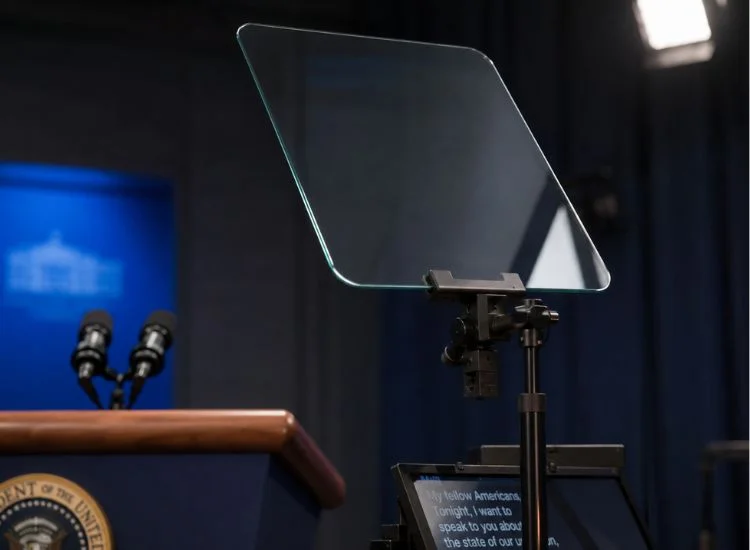
The hardware used in formal political speeches is called a presidential teleprompter or speech prompter. The system has three core components:
This is distinct from the camera teleprompter setup used in broadcast and video production. For a full comparison, see the most common types of teleprompters.

Critics of teleprompter use in political speeches argue that reading from a screen is inherently inauthentic: that the speaker is mouthing words written by someone else, delivered with an artificial smoothness that real conviction would not require.
That criticism misreads how professional teleprompter use actually works.
A speaker who has rehearsed their script does not experience it as reading. They experience it as confirmation. The words on the glass match what they already know they want to say, at the pace they have already practiced. The script becomes invisible. What remains is the delivery.
When teleprompter use looks robotic or scripted, the cause is almost never the device. It is one of three things:
The tool is neutral. The preparation determines the outcome.
Research on public speaking supports this. Studies show that speakers who maintain meaningful eye contact are perceived as more credible, projecting greater competence, honesty, and confidence, while insufficient eye contact is interpreted as anxiety or lack of self-confidence. (Source: "Talk to Me, Not the Slides," arxiv.org, 2026.) A teleprompter, used well, makes sustained eye contact possible under conditions that would otherwise make it nearly impossible.
See also: Teleprompter.com's roundup of public speaking statistics on delivery and credibility.
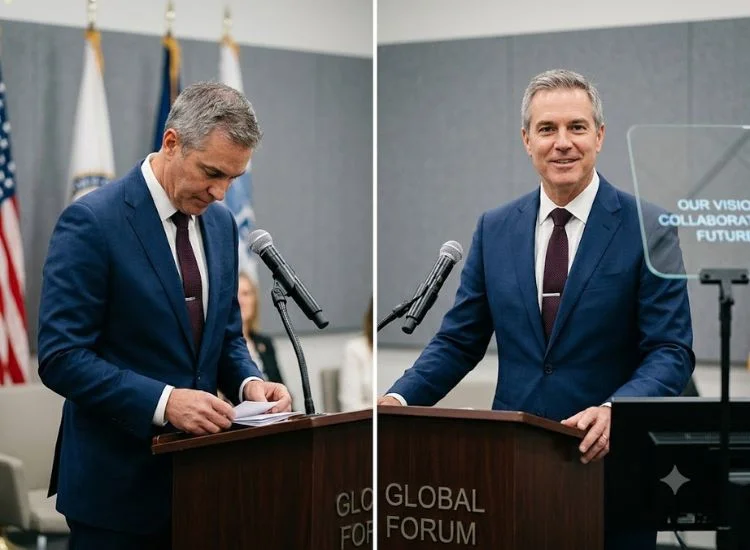
Not every speech requires a teleprompter. Here is how the three main delivery approaches compare across the criteria that matter in high-stakes speaking contexts.
The technique political speechwriters and delivery coaches call 'The Invisible Script' comes down to one principle: the script should disappear. Every decision made before the speaker steps to the podium serves that goal.
Four practices determine whether teleprompter use looks natural or mechanical.
Political speeches that read well on screen often fail on delivery. Short sentences, active verbs, and one idea per line give the speaker natural places to breathe and vary their pace. Long, clause-heavy sentences force the speaker to track multiple ideas simultaneously, which shows.
Most people speak at 125 to 150 words per minute in a conversational tone. Emotional or technical content lands better at the lower end of that range. A teleprompter set to the speaker's actual pace removes the friction between reading and speaking. When the speed is wrong, the speaker either rushes or pauses unnaturally waiting for the next line.
One full rehearsal reveals where the script fails: sentences that feel awkward when spoken, phrasing that trips up the delivery, lines that arrive at the wrong emotional moment. The second pass incorporates those fixes and locks in the speaker's cadence. More than two full rehearsals adds diminishing returns for most speakers. The goal is familiarity, not memorization.
Experienced teleprompter users let their eyes lead slightly ahead of their voice. They are not reading word by word. They are confirming what they are about to say. That small shift is what distinguishes delivery that looks memorized from delivery that looks scripted.
For a full guide to practicing this technique, see how to read a teleprompter naturally.

Presidential teleprompters are purpose-built hardware: heavy glass panels, adjustable stands, dedicated operators, and controlled environments. They are not practical for anyone outside a formal broadcast or political setting.
But the technique behind them is fully transferable.
The scroll-and-read principle that has driven political speech delivery since 1954 now runs on any phone, tablet, Mac, or web browser. A browser-based teleprompter requires no installation and no hardware rig. You write your script, set your scroll speed to match your natural pace, and deliver it to camera while the text moves in front of you. The glass panels are gone. The technique is the same.
Explore the full feature set at Teleprompter.com platform features, including four adjustable scroll modes, among them VoiceGlide voice-activated scrolling, plus mirror mode for beam splitter rigs, cloud script import, and remote control support across Bluetooth devices and Apple Watch.
Teleprompters in political speeches are not a shortcut. They are a delivery tool that removes the one constraint that would otherwise force a speaker's eyes off their audience: the need to hold thousands of words in working memory while performing under pressure.
The technology has not changed the fundamental skill required. A speaker still needs command of their material, a script written for the ear, and enough rehearsal that the words feel like their own. What the teleprompter changes is the ceiling. It makes consistent, precise, eye-contact-driven delivery possible at a scale no memorization or notecard system can match.
That technique has been standard in professional political communication since 1954. The same principle now runs on any browser or mobile device, without the glass panels or the operator.
Teleprompters eliminate the memory risk in high-stakes communication. A misstated word can define a news cycle; a prepared script removes that variable without sacrificing delivery.
The glass panels are visible from the side of the room but transparent to cameras. What audiences notice is the delivery: a rehearsed speaker looks memorized; an unrehearsed one looks like they're reading.
No. Teleprompter use in political speeches is standard professional practice. The speaker knows the material and approves the script; the device ensures precision, not deception.
President Dwight D. Eisenhower was the first, using a teleprompter designed by Hubert Schlafly for a formal address in 1954.
A presidential teleprompter uses two angled glass panels beside the podium that reflect scrolling text visible only to the speaker. Camera teleprompters mount a screen directly in front of the lens for broadcast and video use.
Yes. App-based teleprompters bring the same scroll-and-read technique to any phone, tablet, or browser with no operator or hardware rig required.


.png)


.png)